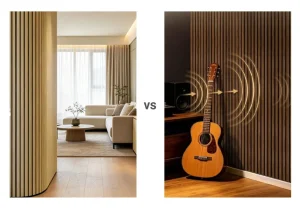
When sourcing acoustic wall panels for commercial interiors, offices, hotels, educational facilities, and public buildings, buyers often face an important decision: should they choose flexible acoustic panels or standard acoustic panels?
Although both products are designed to improve indoor acoustic comfort, they differ significantly in material structure, flexibility, installation methods, design possibilities, application scenarios, and purchasing considerations. Selecting the wrong type can affect installation efficiency, project costs, visual consistency, and long-term performance.
For importers, wholesalers, distributors, architects, interior designers, and construction contractors, understanding these differences is essential before placing a bulk order.
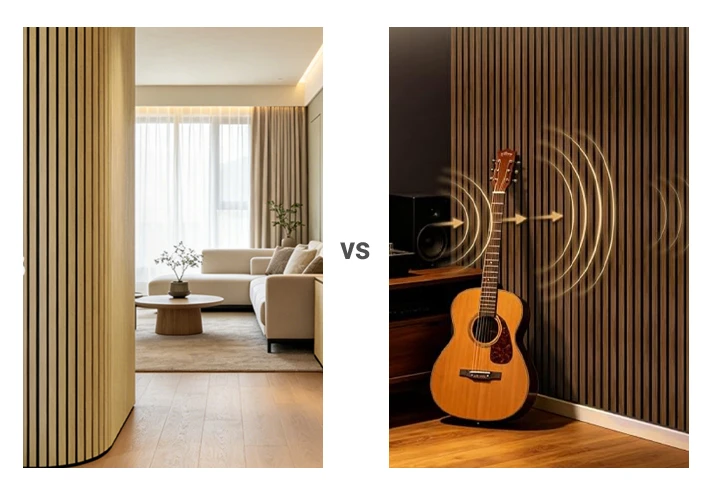
Flexible acoustic panels are designed to adapt to curved surfaces, irregular structures, and creative architectural designs. They are particularly useful when conventional rigid panels cannot follow the required wall or ceiling shape.
Standard acoustic panels, on the other hand, generally feature rigid or semi-rigid structures and are commonly used for flat walls, ceilings, meeting rooms, offices, classrooms, and other conventional interior spaces.
As a professional acoustic panel manufacturer in China, AesthEdge provides acoustic wall panel solutions for commercial interior projects and international B2B buyers. This guide compares both product categories from a practical purchasing perspective, helping buyers evaluate their differences and select the right solution for different project requirements.
What Are Flexible Acoustic Panels and Standard Acoustic Panels?
Before comparing their advantages and limitations, buyers should understand how these two acoustic panel categories are constructed and how their structures influence their performance.
Although both products are used for interior acoustic treatment, their physical characteristics and installation capabilities are different.
What Are Flexible Acoustic Panels?
Flexible acoustic panels are acoustic materials engineered to bend, curve, or adapt to selected non-flat surfaces without losing their basic structural integrity.
Unlike conventional rigid boards, flexible panels may use bendable substrates, flexible fiber structures, grooved backing systems, or specially engineered composite materials. Their construction depends on the manufacturer’s product design and intended application.
Common materials used in flexible acoustic panel systems include:
- PET felt: Made from polyester fibers, often incorporating recycled polyester. It can be manufactured into lightweight sheets with different thicknesses, densities, colors, and surface patterns.
- Flexible acoustic foam: Open-cell foam structures can adapt to certain curved surfaces and provide sound absorption.
- Flexible wood-based acoustic systems: MDF or wood veneer panels with engineered grooves, segmented structures, or specialized backing that allows installation on curved surfaces.
- Flexible fiber composites: Polyester fiber and other acoustic materials designed to accommodate selected architectural shapes.
- Fabric-based acoustic systems: Acoustic cores combined with flexible fabric finishes that can follow certain curved structures.
One important point for buyers is that not every product marketed as a flexible acoustic panel can be bent freely. The minimum bending radius, panel thickness, material density, and installation method determine its actual flexibility.
For example, some PET acoustic panels can be cut or grooved to create curved designs, while other products require a pre-shaped supporting structure.
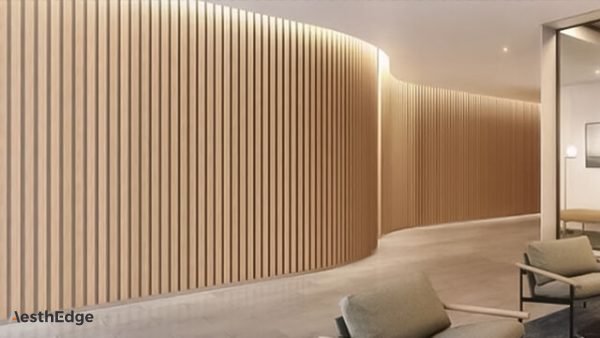
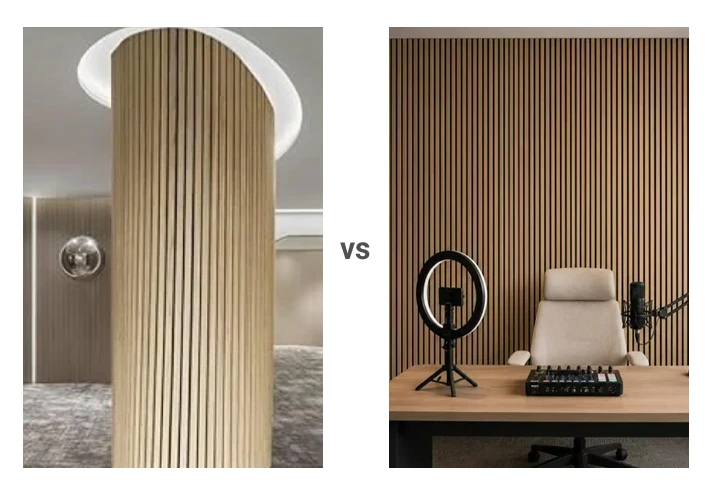
Flexible acoustic panels are especially useful in projects where interior designers want to combine sound absorption with architectural creativity. They can help create continuous decorative surfaces around curved walls, circular columns, rounded reception areas, and other non-linear structures.
What Are Standard Acoustic Panels?
Standard acoustic panels generally refer to conventional flat or rigid acoustic products designed for installation on walls and ceilings.
They typically consist of an acoustic absorption core, a decorative surface, and sometimes a supporting frame or backing structure.
Common material options include:
- Polyester fiber acoustic boards
- Mineral wool acoustic panels
- Fiberglass acoustic panels
- Fabric-wrapped acoustic panels
- MDF acoustic slat panels
- Perforated wood acoustic panels
- Acoustic foam boards
Different materials provide different levels of sound absorption, structural rigidity, fire performance, and decorative flexibility.
For example, fabric-wrapped acoustic panels commonly use a fiberglass or mineral wool core with an acoustically transparent fabric covering. Other products, such as decorative acoustic slat panels, combine a wood-based decorative face with an acoustic backing layer.
Standard acoustic panels are generally available in rectangular, square, and other regular geometric formats. They are suitable for conventional flat-wall and ceiling installations.
For commercial projects, standard panels are often selected because they offer predictable dimensions, straightforward installation planning, and a wide range of decorative options.
Understanding the Main Difference
The most fundamental difference is not simply whether a panel is soft or hard.
It is whether the product has been engineered to accommodate curved or irregular installation surfaces.
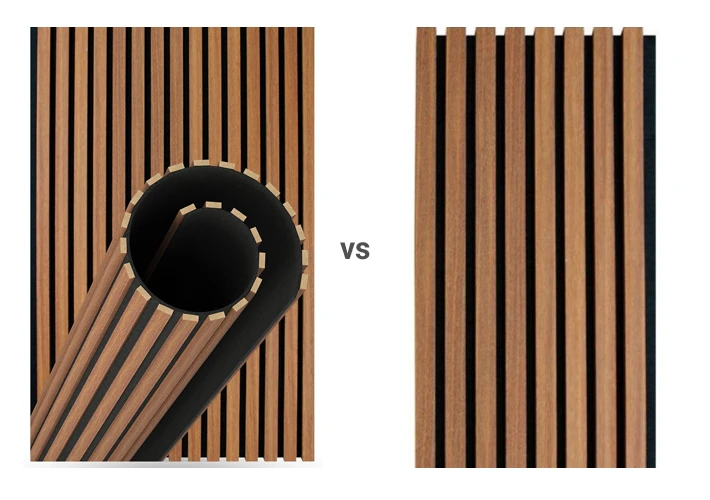
A flexible panel is intended to provide greater geometric adaptability, while a conventional standard panel is generally optimized for flat surfaces and regular installation layouts.
Both categories can provide effective acoustic treatment. Their actual performance must be evaluated using the relevant product specifications and test results rather than their names alone.
Flexible Acoustic Panels vs Standard Acoustic Panels: 8 Key Differences
For international buyers, choosing between these two products requires more than comparing appearance and unit prices.
The following comparison highlights eight important purchasing factors.
1. Material Structure and Construction
Material construction directly affects flexibility, weight, durability, installation requirements, and acoustic performance.
Flexible acoustic panels generally use materials or structural designs that allow controlled bending or adaptation.
For example, PET felt panels may be manufactured with different densities and thicknesses to balance acoustic absorption and flexibility. Grooved or segmented products can also accommodate selected curves without requiring the entire panel material to deform.
Some flexible wood acoustic products use engineered grooves or supporting structures to achieve curved shapes. These products are different from ordinary flat MDF acoustic panels.
Standard acoustic panels generally prioritize dimensional stability and structural rigidity.
Typical construction includes:
- A rigid or semi-rigid sound-absorbing core.
- A fabric, wood, PET, or decorative surface.
- A backing board or frame where required.
- Mounting accessories or installation hardware.
The structure is designed to maintain a consistent shape after installation.
Buyer consideration: If your project requires curved surfaces, ask the manufacturer about the actual bending mechanism rather than assuming every flexible-looking product can accommodate any radius.
2. Flexibility and Shape Adaptability
This is the most obvious difference between the two categories.
Flexible acoustic panels can accommodate selected curved and irregular surfaces. Depending on their construction, they may be installed around columns, curved partitions, cylindrical structures, and rounded architectural details.
Standard acoustic panels are generally designed for flat surfaces.
Although custom-shaped rigid panels can be manufactured, their geometry is usually produced through factory cutting, molding, or fabrication rather than on-site bending.
| Comparison | Flexible Acoustic Panels | Standard Acoustic Panels |
|---|---|---|
| Flat wall installation | Yes | Yes |
| Curved wall installation | Suitable models | Limited or custom-made |
| Round column installation | Suitable models | Usually requires segmented panels |
| Irregular surfaces | Greater adaptability | Requires additional fabrication |
| On-site bending | Depends on product design | Generally unsuitable |
| Custom geometry | Available | Available, often through rigid fabrication |
For example, consider a hotel reception area with a large curved decorative wall.
Using conventional rectangular acoustic panels may require multiple small sections, additional joints, and careful cutting. A suitable flexible acoustic system may create a more continuous appearance.
However, buyers should always confirm the minimum bending radius and the compatibility between the panel and the supporting surface.
3. Sound Absorption and Acoustic Performance
A common misconception is that flexible acoustic panels automatically provide better sound absorption than standard acoustic panels.
This is not necessarily true.
Acoustic performance depends on several factors, including:
- Core material.
- Material density.
- Panel thickness.
- Porosity and airflow resistance.
- Surface treatment.
- Installation method.
- Air cavity behind the panel.
- Frequency range being evaluated.
The Noise Reduction Coefficient (NRC) is commonly used to summarize sound absorption performance.
An NRC value provides an overall indication of how much sound a material absorbs under specified laboratory conditions. It should not be treated as a complete description of performance at every frequency or in every installation.
For example, a flexible PET felt panel may provide good absorption in certain frequency ranges, while a thicker rigid mineral wool panel may offer stronger absorption across a broader range.
Installation conditions also matter. A panel installed directly against a wall may perform differently from the same panel installed with an air gap.
One published PET felt panel specification, for instance, reports NRC 0.30 when mounted directly on a wall, increasing to approximately 0.65 with a 50 mm air gap and approximately 0.80 with a 150 mm air gap. These figures illustrate why mounting conditions must be considered when comparing products.
For standard acoustic panels, thickness and core construction can significantly influence their absorption characteristics. Fiberglass and mineral wool are commonly used in products designed for commercial acoustic treatment.
What should buyers request?
When evaluating flexible and standard acoustic panels, request:
- NRC or SAA test results.
- Sound absorption coefficients across different frequencies.
- Testing standards and laboratory information.
- Panel thickness and density.
- Mounting configuration used during testing.
- Performance information for the complete installed system, where available.
Do not compare two products based only on an NRC number if they were tested under different mounting conditions.
4. Installation Methods and Labor Requirements
Installation is another important factor that affects total project cost.
Flexible acoustic panels may be installed using:
- Construction adhesive.
- Mechanical fasteners.
- Specialized clips.
- Supporting frames.
- Pre-shaped substrates.
- Modular fixing systems.
The correct method depends on the panel’s weight, thickness, material structure, curvature, and installation location.
For curved surfaces, installers must carefully measure the radius and ensure that the panel follows the substrate without excessive tension, deformation, or visible gaps.
Some flexible panels can be bent during installation, while others must be prepared or shaped in advance.
Standard acoustic panels generally offer more straightforward installation procedures.
Common methods include:
- Adhesive mounting.
- Screws and mechanical fasteners.
- Z-clips.
- Impaling clips.
- Concealed mounting systems.
- Suspended ceiling systems.
For example, certain fabric-wrapped acoustic panel systems use mechanical clips and screws to provide secure and removable installation.
From a contractor’s perspective, standard acoustic panels may require less specialized installation knowledge when the project consists mainly of flat walls and ceilings.
Flexible panels can reduce the need for complicated segmentation on suitable curved surfaces, but they may require more accurate measurements and experienced installers.
Therefore, the most economical option should be determined by comparing the entire installation process rather than the panel price alone.
5. Design Possibilities and Decorative Effects
Acoustic panels are no longer selected only for their sound absorption capabilities.
In modern commercial interiors, they are also important decorative materials.
Flexible acoustic panels provide more possibilities for architectural designs involving curves, flowing lines, and continuous surfaces.
Popular applications include:
- Curved feature walls.
- Rounded reception backgrounds.
- Decorative column coverings.
- Organic wall patterns.
- Curved ceiling elements.
- Creative partitions.
- Customized geometric installations.
Standard acoustic panels are particularly suitable for organized and symmetrical interior designs.
Popular applications include:
- Rectangular acoustic wall arrangements.
- Vertical wood slat feature walls.
- Horizontal decorative panels.
- Office meeting room backgrounds.
- Classroom acoustic walls.
- Ceiling acoustic treatments.
- Modular wall decoration.
The available decorative finishes also differ according to the product category.
Flexible panels may feature colored PET felt, textured surfaces, grooved patterns, or flexible wood finishes.
Standard panels may offer fabric coverings, wood veneer, melamine finishes, perforated MDF, and different acoustic surface patterns.
For buyers serving different markets, both categories can create commercial value because they address different architectural preferences.
6. Durability and Maintenance
Durability should be considered carefully, particularly for projects involving hotels, shopping centers, offices, schools, and other high-traffic commercial environments.
Flexible acoustic panels must maintain their intended shape during normal use.
Their long-term suitability depends on:
- Material quality.
- Resistance to repeated deformation.
- Surface wear resistance.
- Moisture conditions.
- Installation quality.
- Exposure to sunlight.
- Cleaning requirements.
Some flexible products are designed for permanent curved installation rather than repeated bending.
Buyers should not assume that a panel can be bent repeatedly simply because it is marketed as flexible.
Standard acoustic panels generally maintain their shape through a rigid or semi-rigid structure.
Their durability depends on the core material, surface finish, frame construction, edge treatment, and fixing system.
For example, fabric-wrapped products may require more careful cleaning than certain finished PET or wood-based panels.
In commercial applications, it is advisable to confirm:
- Whether the surface can be wiped clean.
- Whether the product resists scratching.
- Whether the material is suitable for the expected humidity.
- Whether the edges are protected.
- Whether replacement panels can be supplied later.
For hotel corridors, reception areas, and public buildings, surface durability and maintenance access should be included in the purchasing specification.
7. Customization and Manufacturing Capabilities
Customization is especially important for international B2B buyers.
Different projects may require specific dimensions, colors, surface patterns, thicknesses, densities, and installation accessories.
Flexible acoustic panels often require more attention to manufacturing details because flexibility must be balanced with dimensional stability and acoustic performance.
Possible customization options include:
- Different panel thicknesses.
- Custom colors.
- Various surface textures.
- Grooved or patterned designs.
- Custom bending radii for compatible products.
- Special cutting dimensions.
- Project-specific mounting systems.
Standard acoustic panels also offer extensive customization possibilities.
For example, manufacturers may provide:
- Different board dimensions.
- Multiple thickness options.
- Custom wood veneer finishes.
- Different slat widths and spacing.
- PET felt backing colors.
- Perforation patterns.
- Customized acoustic configurations.
For wholesalers and distributors, it is important to work with a manufacturer that can maintain consistent specifications across repeat orders.
Color consistency, dimensional tolerance, packaging, batch management, and production lead time can all influence the success of a large commercial order.
As a China-based acoustic panel supplier, AesthEdge focuses on providing product solutions for international buyers seeking coordinated decorative and acoustic materials.
Before confirming a bulk order, buyers should obtain physical samples and approve the final surface finish, color, dimensions, and technical specifications.
8. Cost and Overall Project Budget
Price is often one of the first considerations when comparing flexible and standard acoustic panels.
However, the cheapest product per square meter does not always produce the lowest total project cost.
Flexible acoustic panels may involve additional costs associated with specialized materials, customized fabrication, curved supporting structures, or more complicated installation requirements.
Standard acoustic panels may benefit from standardized production dimensions and relatively straightforward installation procedures.
The total project cost should include:
| Cost factor | Flexible Acoustic Panels | Standard Acoustic Panels |
|---|---|---|
| Material price | Depends on flexibility and construction | Depends on core and finish |
| Custom fabrication | May be higher for special curves | Usually predictable for regular sizes |
| Installation labor | May require specialized skills | Often more straightforward |
| Supporting structure | May require curved substrates | Usually standard mounting systems |
| Transportation | Depends on packaging and product flexibility | Depends on panel size and rigidity |
| Maintenance | Depends on surface and material | Depends on surface and material |
| Replacement | Depends on model availability | Often easier with standardized sizes |
For large commercial projects, buyers should compare quotations based on the same technical requirements.
A flexible panel with a higher unit price may still be a better option if it reduces complicated cutting, multiple joints, or additional decorative finishing.
Likewise, standard acoustic panels may offer better value for projects with large areas of flat walls and regular layouts.
The right choice depends on the project design, technical requirements, installation budget, and expected service life.
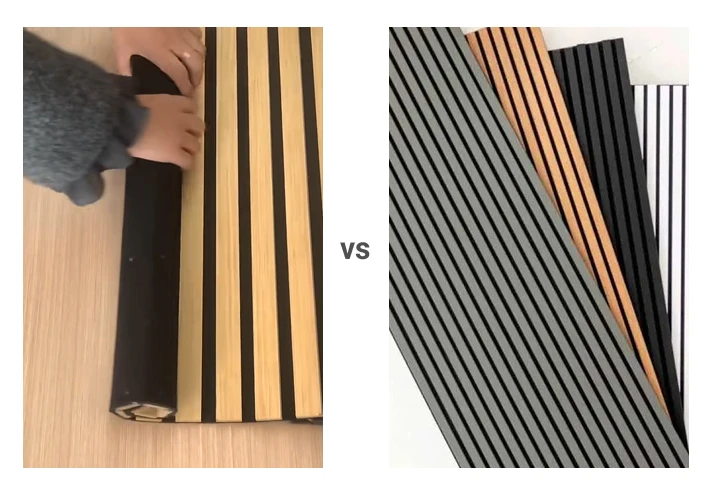
Which Acoustic Panels Are Better for Different Commercial Applications?
There is no universal answer to whether flexible acoustic panels or standard acoustic panels are better.
The most suitable product depends on the architectural structure, acoustic objectives, interior design, and installation conditions.
For B2B buyers, understanding the relationship between product characteristics and project applications helps prevent unnecessary procurement costs.
Offices and Corporate Workspaces
Modern offices often require acoustic materials to improve speech clarity, reduce distracting reflections, and create comfortable working environments.
Standard acoustic panels are generally a practical choice for:
- Open-plan office walls.
- Conference rooms.
- Meeting room backgrounds.
- Employee collaboration areas.
- Training rooms.
- Office ceilings.
In these environments, rectangular or modular acoustic panels can be arranged in different patterns to create a professional appearance.
Flexible acoustic panels are more suitable when an office features curved partitions, rounded reception areas, or distinctive architectural elements.
For example, an office reception area with a curved feature wall may benefit from a flexible acoustic finish that follows the wall’s shape.
Buyer recommendation: Standard acoustic panels are generally more economical for conventional office layouts, while flexible panels are worth considering for architectural feature areas.
Hotels and Hospitality Projects
Hotels have diverse acoustic and decorative requirements.
Reception areas, guest corridors, conference rooms, restaurants, and public lounges all require different interior material solutions.
Standard acoustic panels are suitable for:
- Hotel conference rooms.
- Guest lounge walls.
- Restaurant acoustic treatments.
- Meeting room feature walls.
- Guest corridor decorative surfaces.
Flexible acoustic panels can be particularly useful for:
- Curved hotel reception backgrounds.
- Rounded decorative columns.
- Organic feature walls.
- Curved restaurant partitions.
- Special architectural ceiling designs.
For hotel contractors and FF&E procurement companies, appearance, fire safety documentation, cleaning requirements, and consistent product supply are important purchasing considerations.
A combination of flexible and standard panels may be more practical than using one product throughout the entire property.
Schools and Educational Facilities
Schools, universities, and training centers need acoustic solutions that support speech intelligibility and reduce excessive reverberation.
Common installation areas include:
- Classrooms.
- Libraries.
- Lecture rooms.
- Corridors.
- Training centers.
- Multipurpose halls.
Standard acoustic panels are often suitable because educational buildings generally feature flat walls and regular ceiling structures.
Their modular dimensions also make it easier to plan large-scale installations.
Flexible acoustic panels may be used in curved learning spaces, special activity rooms, or architectural areas where standard boards are difficult to install.
For educational projects, buyers should pay particular attention to fire performance, impact resistance, cleaning requirements, and the relevant acoustic test results.
Restaurants and Cafés
Restaurants often experience significant sound reflections because of hard flooring, glass surfaces, ceilings, and large dining areas.
Excessive reverberation can make conversations uncomfortable, especially during busy dining periods.
Standard acoustic panels can be installed on walls and ceilings to reduce unwanted sound reflections.
Flexible panels offer additional decorative possibilities for restaurants with curved walls, rounded seating areas, and creative interior concepts.
For restaurant material suppliers and contractors, a combination of decorative appearance, cleanability, and acoustic performance should guide product selection.
Auditoriums, Studios, and Multipurpose Spaces
Auditoriums, recording studios, and multipurpose halls generally require more detailed acoustic planning than ordinary offices.
The acoustic requirements may include controlling reverberation, managing frequency-dependent absorption, and addressing sound reflections at specific locations.
Standard acoustic panels are commonly used in these environments because they can be specified with particular core materials, thicknesses, and mounting systems.
Flexible acoustic products may be incorporated into curved architectural surfaces or special acoustic designs.
However, buyers should not select panels for professional sound environments based on appearance or flexibility alone. They should request frequency-dependent acoustic test data and consult an acoustic designer when necessary.
Commercial Buildings and Public Facilities
Shopping malls, exhibition centers, transportation facilities, and other public buildings often combine large open spaces with distinctive architectural structures.
Standard acoustic panels can cover conventional flat walls and ceiling areas, while flexible systems can accommodate selected curved architectural features.
For projects involving large quantities, procurement teams should also consider:
- Consistent color batches.
- Replacement availability.
- Packaging and transportation.
- Installation efficiency.
- Fire performance.
- Maintenance access.
- Product documentation.
These factors can be just as important as the initial material selection.
How to Choose Between Flexible and Standard Acoustic Panels: A Practical Buyer Checklist
For importers, distributors, contractors, and project procurement managers, choosing an acoustic panel requires evaluating more than product appearance.
The following checklist can help buyers identify the most suitable product before requesting a quotation from a manufacturer.
Step 1: Identify the Installation Surface
Start by examining the architectural drawings and identifying the surfaces that need acoustic treatment.
Ask the project team:
- Are the walls completely flat?
- Are there curved walls or rounded columns?
- Does the design include irregular geometric surfaces?
- Will the panels be installed on walls, ceilings, or both?
- Is a supporting frame already available?
If the installation area is mainly flat, standard acoustic panels are often a suitable starting point.
If the project includes curved surfaces, investigate flexible acoustic products with a verified bending capability.
Step 2: Define the Acoustic Requirements
Not every project has the same acoustic objectives.
A meeting room may prioritize speech clarity, while a restaurant may need to reduce excessive reverberation.
A recording studio may require more precise acoustic treatment across multiple frequency ranges.
Before selecting products, clarify:
- The required NRC or SAA.
- The target reverberation time.
- The important frequency ranges.
- The percentage of wall or ceiling coverage.
- Whether the product will be installed directly against the wall.
- Whether an air cavity is required.
It is important to distinguish sound absorption from sound insulation.
Acoustic wall panels generally absorb sound energy inside a room and help control reflections. They do not automatically prevent sound from passing through walls or partitions.
If a project requires sound isolation between rooms, additional construction measures such as insulated wall assemblies, sealed doors, and appropriate barrier systems may be necessary.
Step 3: Evaluate the Material and Product Structure
Different acoustic panel materials have different characteristics.
The following table provides a general purchasing reference.
| Material | Main characteristics | Typical applications |
|---|---|---|
| PET felt | Lightweight, decorative, available in different colors and thicknesses | Offices, schools, feature walls |
| Polyester fiber | Fiber-based acoustic material with multiple density options | Commercial interiors |
| Mineral wool | Rigid or semi-rigid acoustic core | Commercial acoustic treatment |
| Fiberglass | Sound-absorbing core available in different thicknesses | Studios, offices, conference rooms |
| MDF acoustic panels | Wood-based decorative acoustic construction | Hotels, offices, reception areas |
| Acoustic foam | Open-cell sound-absorbing structure | Studios and selected interior applications |
The table describes common material categories rather than guaranteeing that every material is suitable for both flexible and standard panel construction.
Buyers should confirm the actual product structure and technical documentation with the manufacturer.
Step 4: Check Fire Safety and Environmental Documentation
For commercial building projects, fire performance is an important procurement requirement.
Different countries and construction projects may require different testing standards and classifications.
Depending on the destination market, buyers may need documentation relating to:
- ASTM E84.
- EN 13501-1.
- Relevant national fire safety standards.
- VOC emissions.
- Formaldehyde emissions, where applicable.
- Recycled material content.
- Product environmental declarations, where available.
Not every acoustic panel has the same certification.
For example, PET felt, MDF-based panels, fabric-wrapped fiberglass panels, and mineral wool products have different material compositions and fire performance characteristics.
Always request documentation for the exact product construction, including its surface finish, backing, adhesive, and other relevant components.
A certificate for one product model should not automatically be treated as certification for an entire product range.
Step 5: Confirm Dimensions and Installation Details
Before ordering, request the manufacturer’s detailed dimensional specifications.
Important information includes:
- Standard length and width.
- Thickness.
- Weight per panel.
- Material density.
- Edge treatment.
- Minimum bending radius, where applicable.
- Mounting accessories.
- Required installation clearance.
- Packaging dimensions.
For flexible products, the minimum bending radius is particularly important.
For standard products, dimensional tolerance and panel alignment are important for creating a consistent wall or ceiling finish.
Step 6: Request Physical Samples
Physical samples help buyers evaluate quality before placing large orders.
A sample can be used to inspect:
- Surface texture.
- Color consistency.
- Material density.
- Panel thickness.
- Edge finishing.
- Flexibility.
- Installation compatibility.
- Overall appearance.
For decorative acoustic panels, buyers should evaluate the product under lighting conditions similar to the actual project.
This is particularly important for large hotel and office projects where color consistency across multiple production batches matters.
Step 7: Compare the Total Procurement Cost
A professional quotation should provide more than a price per square meter.
Buyers should compare:
- Unit price.
- Minimum order quantity.
- Customization charges.
- Sample costs.
- Packaging specifications.
- Production lead time.
- Shipping dimensions and estimated freight.
- Replacement and after-sales support.
For distributors, the supplier’s ability to maintain consistent product quality and repeat-order specifications should also be considered.
Flexible vs Standard Acoustic Panels: Quick Decision Guide
Choose flexible panels
When the project prioritizes architectural adaptability
- Curved walls and round columns.
- Organic decorative shapes.
- Continuous curved feature surfaces.
- Special interior design concepts.
- Suitable substrates with verified bending radii.
Choose standard panels
When the project prioritizes conventional installation
- Flat office walls.
- Conference rooms.
- Classrooms and libraries.
- Standard acoustic ceilings.
- Large-scale modular installations.
Combine both types
When the project includes multiple architectural surfaces
- Hotels with curved reception areas and flat corridors.
- Offices with feature walls and standard meeting rooms.
- Commercial buildings with different ceiling and wall structures.
What Should Importers and Distributors Look for in an Acoustic Panel Manufacturer?
For international buyers, choosing the right product is only part of the procurement process. Selecting a reliable manufacturer is equally important.
A professional China acoustic panel factory should be able to provide consistent product quality, technical specifications, customization options, and dependable production support.
Here are six important factors to evaluate when selecting a supplier.
1. Manufacturing Experience and Production Capability
Buyers should investigate whether the supplier has actual manufacturing capabilities or primarily operates as a trading company.
A qualified manufacturer should be able to explain its production processes, material sourcing, quality control procedures, and available product specifications.
Important questions include:
- Does the factory manufacture acoustic panels directly?
- What acoustic panel materials can it process?
- Can it manufacture different panel dimensions and thicknesses?
- Does it support customized surface designs?
- Can it handle repeat bulk orders?
- Does it have experience supplying international markets?
For distributors and project contractors, stable production capacity is essential because delayed deliveries can affect the entire construction schedule.
2. Product Customization Options
Different markets have different preferences regarding acoustic panel colors, materials, dimensions, and decorative finishes.
A supplier offering customization can help buyers develop products that match local market demand.
Common customization requirements include:
| Customization item | Buyer requirements |
|---|---|
| Dimensions | Standard or project-specific sizes |
| Thickness | Different thickness options according to product model |
| Colors | Neutral, natural, dark, and customized colors |
| Surface | Smooth, textured, grooved, or decorative finishes |
| Material | PET, polyester fiber, MDF, or other available constructions |
| Shape | Rectangular, geometric, or compatible curved designs |
| Installation | Adhesive, clips, frames, or other suitable systems |
Not all customization options are available for every product. Buyers should confirm manufacturing feasibility before finalizing specifications.
3. Quality Control and Product Consistency
Acoustic panels used in commercial interiors must maintain consistent dimensions, appearance, and material quality.
A professional factory should have quality control procedures covering:
- Raw material inspection.
- Production process monitoring.
- Panel thickness and dimensional checks.
- Surface quality inspection.
- Color consistency.
- Edge finishing.
- Packaging inspection.
- Final product sampling.
For bulk orders, buyers should request pre-production samples and confirm the approved specifications before mass production.
4. Testing Reports and Product Documentation
Technical documentation is essential for international procurement.
Depending on the project and destination market, buyers may require:
- Acoustic absorption test reports.
- Fire performance reports.
- Material composition information.
- VOC emission documentation.
- Environmental documentation.
- Installation instructions.
- Product specification sheets.
A supplier should be able to clarify which reports are available for each product model.
Importers should also verify that the reports correspond to the actual product construction being purchased.
5. Packaging and International Shipping
Acoustic panels are often lightweight but can be vulnerable to damage during transportation if improperly packed.
Packaging requirements depend on panel material, thickness, dimensions, and surface finish.
Buyers should discuss:
- Protective film or surface protection.
- Corner protection.
- Carton specifications.
- Pallet packaging.
- Moisture protection.
- Container loading arrangements.
- Shipping marks and product labels.
For large orders, optimized packaging can help reduce transportation costs and minimize damage during handling.
6. OEM and ODM Cooperation
OEM and ODM services are valuable for importers and distributors who want to establish their own acoustic panel product lines.
Depending on manufacturing capabilities, cooperation may include:
- Private-label packaging.
- Customized product dimensions.
- Exclusive color combinations.
- Customized surface patterns.
- Product development.
- Project-specific specifications.
Before entering a long-term cooperation agreement, buyers should clarify minimum order quantities, sample approval procedures, production lead times, and intellectual property requirements.
AesthEdge aims to support international B2B buyers with decorative interior material sourcing and project-oriented product solutions from China.
For importers, wholesalers, architects, and contractors, working directly with a factory can make product communication, customization coordination, and bulk procurement more efficient.
Future Trends in Flexible and Standard Acoustic Panels
The commercial acoustic materials market is evolving as architects and interior designers place greater emphasis on combining acoustic comfort, sustainability, and decorative design.
Both flexible and standard acoustic panels are expected to remain important in commercial interior projects.
Several trends are particularly relevant to international buyers.
1. Acoustic Materials with Decorative Functions
Traditional acoustic treatment was often viewed as a technical requirement.
Today, acoustic materials increasingly serve as visible design elements.
Architects are integrating acoustic panels into feature walls, reception backgrounds, meeting rooms, and ceiling designs.
Products with wood textures, natural colors, three-dimensional patterns, and decorative finishes are becoming important options for commercial interiors.
For manufacturers and distributors, this creates opportunities to offer acoustic solutions that combine functional and decorative value.
2. Greater Demand for Curved and Organic Designs
Modern architectural concepts increasingly incorporate rounded forms, flowing lines, and irregular geometric structures.
These designs create opportunities for flexible acoustic panels.
Curved acoustic surfaces can help designers maintain a continuous visual appearance while incorporating sound-absorbing materials.
Potential applications include:
- Curved office reception walls.
- Rounded hotel lobby columns.
- Organic restaurant partitions.
- Curved meeting room backgrounds.
- Decorative ceiling features.
Manufacturers that can provide reliable flexible structures and customized dimensions may be better positioned to serve these specialized projects.
3. Sustainable and Recycled Materials
Sustainability is becoming an important consideration in commercial construction and interior design.
PET acoustic panels made with recycled polyester fibers are one example of materials used in projects seeking to incorporate recycled content.
Other manufacturers are exploring recycled fibers, lower-emission production processes, and more efficient material utilization.
However, buyers should distinguish between marketing claims and verified environmental performance.
When purchasing sustainable acoustic materials, request relevant recycled-content documentation, VOC reports, and environmental certifications where available.
4. Modular Acoustic Panel Systems
Modular products provide practical advantages for large commercial projects.
Standard acoustic panels can be manufactured in repeatable dimensions, making them easier to arrange, replace, and integrate into conventional wall and ceiling systems.
Modular flexible acoustic systems can also be developed for specific curved architectural applications.
For distributors, modular designs can simplify inventory management and provide more predictable product specifications.
5. Integrated Acoustic and Interior Material Solutions
Another important trend is the integration of different decorative materials within one commercial project.
For example, a hotel may combine:
- Acoustic wood slat panels.
- Flexible acoustic feature panels.
- Decorative WPC wall panels.
- Bamboo charcoal wood veneer.
- SPC wall panels.
- Decorative ceiling materials.
This approach allows architects to coordinate colors, textures, and material transitions across different interior spaces.
As a China-based decorative interior materials supplier, AesthEdge recognizes the importance of providing coordinated material options for commercial projects.
The ability to source complementary products from one supplier can simplify communication and material coordination for international buyers.
Frequently Asked Questions About Flexible and Standard Acoustic Panels
1. What is the main difference between flexible acoustic panels and standard acoustic panels?
The main difference is their structural design and installation adaptability.
Flexible acoustic panels are engineered to accommodate selected curved or irregular surfaces, while standard acoustic panels are generally designed for flat wall and ceiling installations.
Both types can provide sound absorption, but their performance depends on material composition, thickness, density, and installation conditions.
2. Are flexible acoustic panels better than standard acoustic panels?
Neither type is universally better.
Flexible panels are advantageous for projects involving curved walls, rounded columns, and special architectural shapes.
Standard panels are generally more practical for conventional flat-wall installations, offices, classrooms, and conference rooms.
The best choice depends on the project design, acoustic requirements, installation conditions, and budget.
3. Can flexible acoustic panels be installed on curved walls?
Yes. Suitable flexible acoustic panels can be installed on curved walls.
However, the minimum bending radius varies according to the material, panel thickness, construction, and installation method.
Some products can be bent during installation, while others require a prepared curved substrate or specialized supporting system.
Buyers should confirm the manufacturer’s bending specifications before ordering.
4. Do flexible acoustic panels provide better sound absorption?
Not necessarily.
Flexibility and sound absorption are two different product characteristics.
A flexible PET panel may provide good acoustic performance, but a thicker mineral wool or fiberglass panel may achieve stronger absorption under certain test conditions.
Buyers should compare NRC values, frequency-dependent absorption coefficients, and installation configurations rather than relying on the product category alone.
5. Are standard acoustic panels suitable for commercial buildings?
Yes.
Standard acoustic panels are widely used in commercial interior applications, including:
- Offices.
- Hotels.
- Schools.
- Conference rooms.
- Restaurants.
- Libraries.
- Public buildings.
- Commercial meeting spaces.
Their regular dimensions and relatively straightforward installation make them suitable for many large-scale projects.
6. Can standard acoustic panels be used on curved surfaces?
Some standard acoustic products can be custom-manufactured into curved shapes, but ordinary rigid rectangular panels generally cannot be bent on-site.
Possible solutions include segmented installation, factory-shaped panels, curved supporting frames, and specially engineered acoustic systems.
The most appropriate option depends on the desired curvature and project budget.
7. What NRC value should buyers look for when purchasing acoustic panels?
There is no single NRC value suitable for every application.
The required acoustic performance depends on room dimensions, interior materials, occupancy, background noise, and the intended acoustic environment.
Buyers should work with project designers to determine the appropriate acoustic targets.
It is also important to check the testing standard and mounting configuration because the same panel can perform differently under different installation conditions.
8. Are flexible acoustic panels suitable for hotel projects?
Yes.
Suitable flexible acoustic panels can be used in hotel reception areas, curved feature walls, decorative columns, and other architectural elements.
Standard acoustic panels may be more appropriate for conference rooms, corridors, and flat decorative walls.
Combining both types can provide greater design flexibility across different hotel spaces.
9. What materials are commonly used in flexible acoustic panels?
Common material options include PET felt, polyester fiber, flexible acoustic foam, and specially engineered wood-based acoustic systems.
The actual flexibility depends on the material construction and manufacturing process.
For example, some wood-based acoustic panels use grooves or segmented structures to accommodate curved installations rather than relying on the natural flexibility of solid MDF.
10. What information should buyers provide when requesting an acoustic panel quotation?
To receive an accurate quotation, buyers should provide:
- Product type.
- Required dimensions and thickness.
- Material preferences.
- Preferred colors and surface finishes.
- Estimated order quantity.
- Installation location.
- Required acoustic performance.
- Destination country.
- Expected delivery schedule.
For flexible acoustic panels, buyers should also provide curved wall drawings, column diameters, or the required bending radius whenever possible.
11. Can AesthEdge provide acoustic panel solutions for overseas B2B projects?
AesthEdge is a China-based decorative interior materials supplier serving international B2B buyers.
We can discuss acoustic panel specifications, product selection, customization requirements, and coordinated interior material sourcing according to project needs.
Importers, wholesalers, architects, and construction contractors are welcome to contact our team for product information, samples, and quotation discussions.
Conclusion: Which Acoustic Panel Should Buyers Choose?
Flexible acoustic panels and standard acoustic panels serve different purposes in modern commercial interiors.
Flexible acoustic panels provide greater design adaptability for curved walls, columns, and irregular architectural structures. Standard acoustic panels offer practical solutions for flat walls, ceilings, offices, educational facilities, and conventional commercial installations.
The best purchasing decision should consider acoustic performance, material construction, installation requirements, decorative appearance, durability, and total project cost.
For international importers and project contractors, selecting a manufacturer with reliable production capabilities, customization options, and clear technical documentation is equally important.
AesthEdge – Your China Factory Partner for Decorative Acoustic Panel Solutions
As a professional China factory supplier of decorative interior materials, AesthEdge supports international B2B buyers seeking acoustic panels and coordinated interior material solutions.
Whether you are sourcing acoustic panels for hotels, offices, educational facilities, commercial buildings, or distribution businesses, our team is ready to discuss your requirements.
Contact AesthEdge to request product details, discuss customization possibilities, and obtain a quotation for your next project.
AesthEdge. Elevate every space!