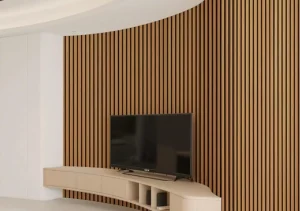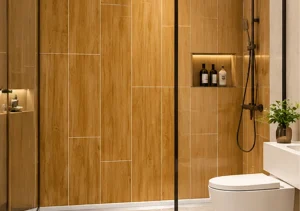
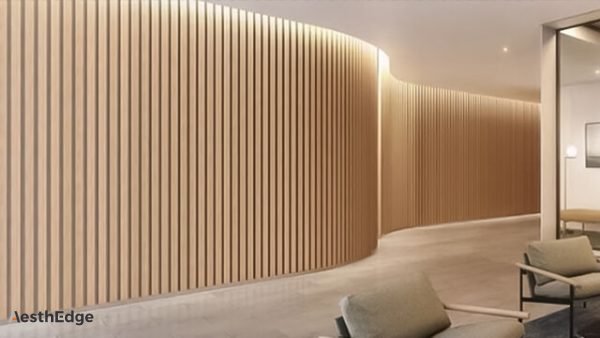
When choosing decorative wall panels for residential, commercial, hospitality, and retail projects, two options are becoming increasingly popular: WPC fluted 3D wall panels and wood slat panels. Both can create a modern architectural appearance, add depth to interior walls, and transform ordinary surfaces into attractive feature walls. However, they are not identical in terms of material, moisture resistance, maintenance, acoustic performance, installation, cost, and long-term use.
For importers, distributors, contractors, architects, and project developers, choosing between WPC fluted 3D wall panels and wood slat panels is not simply a design decision. The right product can affect installation efficiency, maintenance requirements, project costs, and customer satisfaction.
So, which is better: WPC fluted 3D wall panels or wood slat panels?
The answer depends on the project. In humid environments, high-volume commercial projects, and applications where easy maintenance is important, WPC fluted 3D wall panels are often the more practical solution. Wood slat panels can be an excellent choice when natural wood appearance and acoustic performance are the primary priorities.
This guide compares both options in detail and explains how buyers can select the right wall panel for different projects.
What Are WPC Fluted 3D Wall Panels?
WPC stands for Wood Plastic Composite. WPC wall panels are manufactured by combining wood fibers or wood powder with polymer materials and functional additives. The mixture is processed into decorative profiles using extrusion or other forming technologies.
WPC fluted 3D wall panels feature a three-dimensional surface consisting of repeated grooves, flutes, ribs, or linear textures. The vertical profile creates shadows and highlights that make a wall appear deeper and more architectural.
Unlike traditional solid wood, WPC is an engineered composite material. The polymer component gives the product better resistance to moisture, insects, warping, and everyday environmental changes. Depending on the formulation and surface treatment, WPC panels can also be produced with improved scratch resistance, color stability, and fire performance.
Modern WPC wall panels are available in many colors and surface finishes. Wood-grain finishes are especially popular because they provide the visual warmth of timber while reducing some of the maintenance issues associated with natural wood.
WPC wall panels are increasingly used for:
- Living room feature walls
- Hotel interiors
- Restaurant walls
- Office reception areas
- Commercial stores
- Bedrooms
- TV background walls
- Corridors
- Meeting rooms
- Retail displays
- Apartment developments
- Hospitality projects
WPC wall panels are particularly attractive for markets with high humidity. Research and industry sources commonly identify moisture resistance, dimensional stability, low maintenance, and termite resistance as important advantages of WPC compared with traditional wood materials.
For a manufacturer such as AesthEdge, WPC fluted 3D wall panels also provide an opportunity to offer wholesalers and project buyers a standardized decorative product with consistent dimensions, colors, and surface textures.
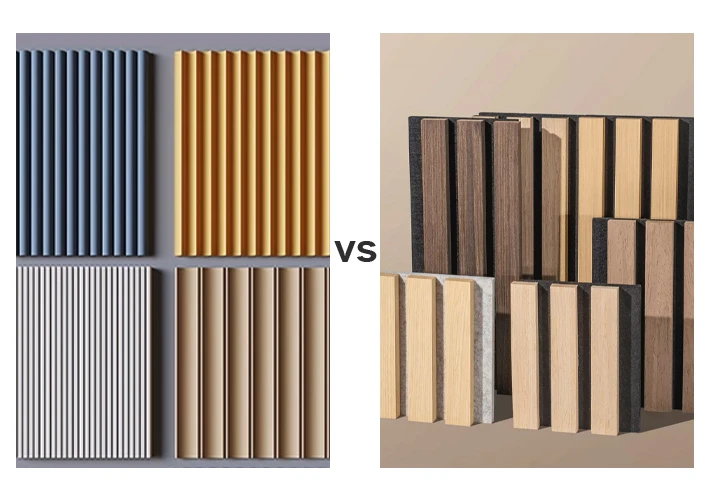
What Are Wood Slat Panels?
Wood slat panels are decorative wall systems made from individual wood slats, wood veneer, engineered wood profiles, or similar linear elements. Many modern acoustic wood slat panels consist of narrow slats mounted onto a felt or acoustic backing.
The characteristic appearance is created by the repeated spacing between individual slats. Compared with a solid fluted surface, the open gaps between slats create a stronger visual rhythm.
Wood slat panels are commonly selected for:
- Home offices
- Living rooms
- Bedrooms
- Restaurants
- Hotels
- Conference rooms
- Music rooms
- Home theaters
- Reception areas
- Executive offices
- Interior feature walls
One important point is that wood slat panels are not necessarily the same as fluted wall panels.
A fluted panel usually has a continuous panel surface with grooves or channels formed into the face. A slat panel consists of separate strips or battens with visible gaps between them. This difference affects both appearance and acoustic behavior.
Wood slat panels can provide a highly natural appearance, especially when real wood veneer or solid timber is used. However, natural wood is hygroscopic, meaning it can absorb and release moisture. Changes in moisture can contribute to dimensional movement, swelling, shrinkage, or warping if the material is not properly selected, finished, installed, and maintained.
Therefore, wood slat panels can work extremely well in controlled interior environments, but buyers need to consider the climate and installation conditions carefully.
WPC Fluted 3D Wall Panels vs Wood Slat Panels: Key Comparison
Before discussing individual factors, the following table provides a quick comparison.
| Feature | WPC Fluted 3D Wall Panels | Wood Slat Panels |
|---|---|---|
| Main material | Wood-plastic composite | Natural wood, veneer, MDF or engineered wood |
| Appearance | Modern, consistent, 3D textured | Natural, warm, linear |
| Moisture resistance | Generally high | Depends strongly on wood and backing |
| Humid environment | Very suitable | Requires careful specification |
| Acoustic performance | Mainly decorative unless acoustic backing is added | Stronger when designed with acoustic felt |
| Maintenance | Low | Moderate |
| Termite resistance | Generally strong | Depends on wood treatment |
| Dimensional stability | Generally good | Depends on material and environment |
| Installation | Relatively fast | Relatively fast, but varies by system |
| Design consistency | High | Natural variation may occur |
| Color consistency | High | Natural wood variation |
| Customization | High | High |
| Commercial projects | Excellent | Excellent |
| Natural wood feel | Good | Excellent |
| Long-term moisture management | Advantage | Requires more attention |
| Typical best use | Decorative, humid, high-volume projects | Premium aesthetic and acoustic interiors |
The comparison shows that neither material is universally better. Instead, each product has specific strengths.
Moisture Resistance: WPC Has the Advantage
One of the biggest differences between WPC fluted wall panels and wood slat panels is their response to moisture.
WPC is engineered with polymer content, which helps reduce water absorption and moisture-related dimensional changes. This makes WPC particularly attractive in humid climates and areas where occasional moisture exposure is expected.
For example, WPC wall panels can be considered for:
- Hotels in tropical climates
- Restaurants
- Commercial interiors
- Apartments
- Bathrooms where the specific product is rated for the application
- Kitchens
- Laundry areas
- Humid coastal regions
However, buyers should not assume that every WPC panel is automatically suitable for every wet application. Product formulation, installation method, edge treatment, substrate condition, and manufacturer specifications still matter.
Wood slat panels require more attention in humid conditions. Wood naturally interacts with moisture, and repeated changes in humidity can cause movement. Proper acclimatization, sealing, ventilation, and installation are important.
For distributors serving tropical or humid markets, WPC fluted 3D wall panels are often easier to position as a low-maintenance decorative wall solution.
Appearance: Wood Slat Panels Offer Natural Authenticity
When it comes to pure natural appearance, real wood has an obvious advantage.
Real wood has natural grain patterns, color variation, and tactile characteristics that are difficult to reproduce perfectly. Premium wood slat panels can create a sophisticated appearance for luxury hotels, high-end offices, villas, restaurants, and residential interiors.
However, WPC technology has improved significantly. Modern WPC fluted panels can feature realistic wood-grain textures, embossed surfaces, and multiple color options.
For large commercial projects, consistency can actually become an advantage.
A project developer may prefer WPC because hundreds or thousands of square meters can maintain a relatively consistent appearance. With natural wood, grain and color variation may be desirable aesthetically but can also make batch matching more difficult.
Therefore:
Choose wood slat panels when natural timber character is the priority.
Choose WPC fluted panels when consistent modern aesthetics are more important.
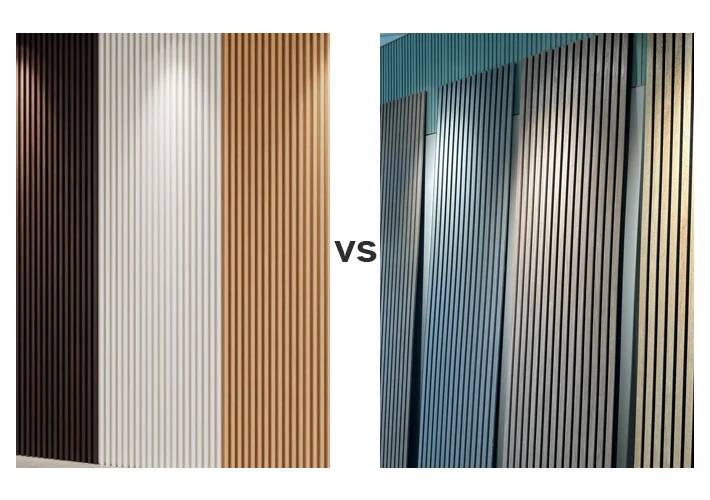
Acoustic Performance: Wood Slat Panels Often Win
Acoustic performance is another important consideration.
A standard decorative WPC fluted panel should not automatically be described as an acoustic panel. Its grooves and three-dimensional profile can change sound reflection compared with a flat surface, but this does not necessarily mean that it provides significant sound absorption.
Wood slat acoustic panels are different.
Many acoustic slat systems combine wood or wood-look slats with an acoustic felt backing. Sound can pass through the gaps between the slats and interact with the backing material. This can help reduce reverberation and improve room acoustics. Industry explanations of acoustic slat systems commonly distinguish them from purely decorative fluted panels for this reason.
However, buyers should understand the difference between sound absorption and soundproofing.
A wall panel may help reduce echo and reverberation inside a room, but that does not mean it will completely block sound transmission between rooms.
For conference rooms, home theaters, offices, restaurants, and other spaces where acoustic comfort matters, buyers should request actual test data such as NRC or equivalent acoustic performance information rather than relying only on marketing claims.
WPC can also be combined with acoustic backing materials to create decorative acoustic wall systems. This allows manufacturers such as AesthEdge to develop WPC solutions that combine visual design with functional acoustic performance.
Maintenance: WPC Is Usually Easier
Maintenance is especially important for commercial buildings.
Natural wood may require periodic cleaning, refinishing, sealing, oiling, or other maintenance depending on the type of wood and finish.
WPC generally requires less routine maintenance. In many interior applications, dust and everyday stains can be removed using a soft cloth and suitable cleaning solution.
This can make WPC attractive to:
- Hotel operators
- Property managers
- Restaurant owners
- Retail chains
- Office developers
- Apartment management companies
For a B2B buyer, low maintenance is not just a convenience. It can become a selling point when distributing wall panels to commercial customers.
A distributor can position WPC as a product that reduces the maintenance burden while maintaining a premium decorative appearance.
Installation: Both Can Be Efficient
Both WPC fluted wall panels and wood slat panels can be relatively easy to install compared with traditional decorative construction methods.
Depending on the product design, installation may use:
- Construction adhesive
- Screws
- Clips
- Furring strips
- Battens
- Combination fixing systems
Large-format WPC panels can help reduce installation time because fewer individual pieces may be required to cover a wall.
Wood slat acoustic panels are also designed for relatively straightforward installation. Some systems can be screwed directly to the wall or fixed using adhesive. However, cutting around sockets, corners, doors, and architectural details still requires accurate measurement and appropriate tools.
For professional contractors, the most important factors are usually:
- Panel dimensions
- Weight per panel
- Cutting requirements
- Fixing method
- Edge treatment
- Trim availability
- Wall flatness
- Installation tolerance
A manufacturer that provides installation instructions, accessories, technical drawings, and packaging suitable for export can significantly improve the contractor experience.
Which Is More Cost-Effective for B2B Projects?
Cost should be evaluated beyond the initial purchase price.
For importers and distributors, the total cost may include:
- Product price
- Packaging
- Shipping
- Import duties
- Installation labor
- Accessories
- Maintenance
- Replacement costs
- Inventory management
WPC fluted panels can be attractive for large-scale projects because their standardized production allows manufacturers to maintain consistent specifications and repeatable colors.
For a China-based manufacturer, production volume can also influence the final price. Larger orders may allow better optimization of raw materials, packaging, container loading, and production scheduling.
Wood slat panels can have a wide price range. MDF-based veneer systems may be relatively accessible, while premium solid wood or high-quality natural veneer products can become significantly more expensive.
There is also an important distinction between decorative value and functional value.
If a buyer needs a decorative wall only, a standard WPC fluted panel may offer an attractive price-performance ratio.
If the buyer needs both premium natural wood aesthetics and acoustic absorption, an acoustic wood slat system may justify the additional cost.
For B2B buyers, the best approach is to compare landed cost per square meter, not only factory price per panel.
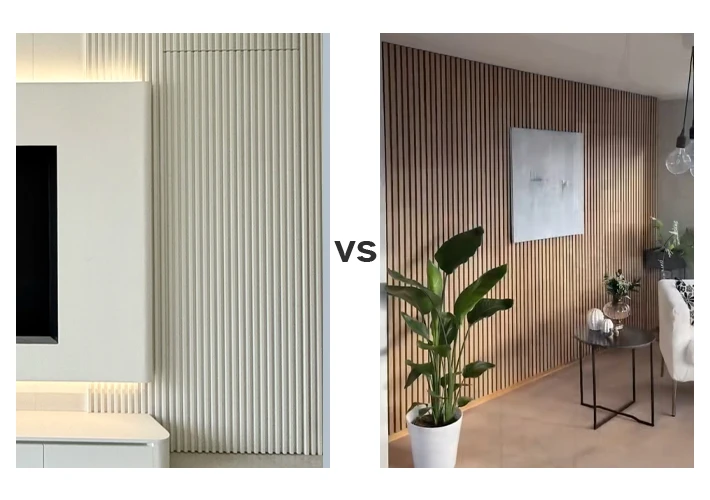
Which Is Better for Different Applications?
The ideal choice changes according to the project environment.
Residential Interiors
Both products work well in residential interiors.
WPC fluted 3D wall panels are particularly suitable for TV walls, living rooms, bedrooms, corridors, and feature walls where low maintenance is important.
Wood slat panels are popular for bedrooms, home offices, living rooms, and entertainment areas where warmth and acoustic comfort are desired.
Hotels
Hotels often require materials that combine aesthetics, durability, easy maintenance, and consistent supply.
WPC can be a strong choice for:
- Hotel corridors
- Guest room feature walls
- Reception areas
- Restaurant interiors
- Decorative partitions
Wood slat acoustic panels can be particularly attractive in restaurants, conference rooms, lounges, and lobby spaces where sound control is important.
Offices
Modern offices increasingly use linear wall designs to create visual rhythm.
WPC fluted panels can provide a clean corporate appearance with consistent production.
Wood slat acoustic panels may provide additional acoustic benefits, which can be valuable in open-plan offices and meeting spaces.
Restaurants and Cafés
Restaurants often need both attractive design and practical maintenance.
WPC has an advantage when humidity, cleaning, and durability are important.
Wood slat panels are attractive when the design concept emphasizes natural materials and acoustic comfort.
Humid and Tropical Markets
For tropical markets, WPC is often the safer starting point.
High humidity can create challenges for natural wood and engineered wood products. WPC’s resistance to moisture-related problems makes it attractive for markets such as Southeast Asia and other humid regions.
However, correct installation remains essential. Moisture problems in the substrate or behind the wall cannot be solved simply by installing a decorative panel.
What Should Importers Check Before Buying?
For importers and distributors, product selection should go beyond appearance.
Before placing a bulk order, buyers should request a complete technical specification.
1. Material Composition
Ask the manufacturer what the WPC formulation contains and whether the product uses PVC, PE, PP, wood fiber, or other components.
For wood slat panels, identify whether the product is solid wood, veneer, MDF, plywood, or another engineered substrate.
2. Dimensions and Tolerances
Confirm:
- Panel length
- Width
- Thickness
- Weight
- Groove dimensions
- Slat spacing
- Dimensional tolerance
Consistent dimensions are especially important when panels are used across large commercial walls.
3. Surface Finish
Request samples before purchasing.
Check:
- Color consistency
- Grain appearance
- Texture
- Gloss level
- Scratch resistance
- Edge quality
- Batch consistency
4. Moisture Performance
If the products will be sold in humid markets, ask for relevant moisture and water-resistance information.
Do not rely only on the word “waterproof” in marketing materials. Buyers should understand exactly how the product has been tested and what applications are approved.
5. Fire Performance
For hotels, public buildings, offices, and commercial developments, fire performance can be an important purchasing criterion.
The required rating varies by country and building application. Buyers should request valid test reports and confirm whether they meet the standards required in the destination market.
6. Acoustic Data
If acoustic performance is part of the product positioning, request actual test data.
Ask for:
- NRC
- Sound absorption coefficient
- Test frequency range
- Test standard
- Backing material
- Installation configuration
A decorative fluted surface should not be marketed as a high-performance acoustic system unless the complete construction has been tested.
7. Packaging and Container Loading
For B2B importers, packaging is critical.
Ask the factory about:
- Individual protection
- Carton size
- Pallet requirements
- Container loading quantity
- Moisture protection
- Corner protection
- Export labeling
Good packaging can reduce damage claims and improve warehouse handling.
8. OEM and ODM Capability
For distributors building their own brand, OEM and ODM services can be valuable.
Ask whether the factory can provide:
- Custom colors
- Custom dimensions
- Custom packaging
- Logo printing
- Private-label cartons
- New surface designs
- Customized accessories
This is particularly important when competing in mature markets where distributors want product differentiation.
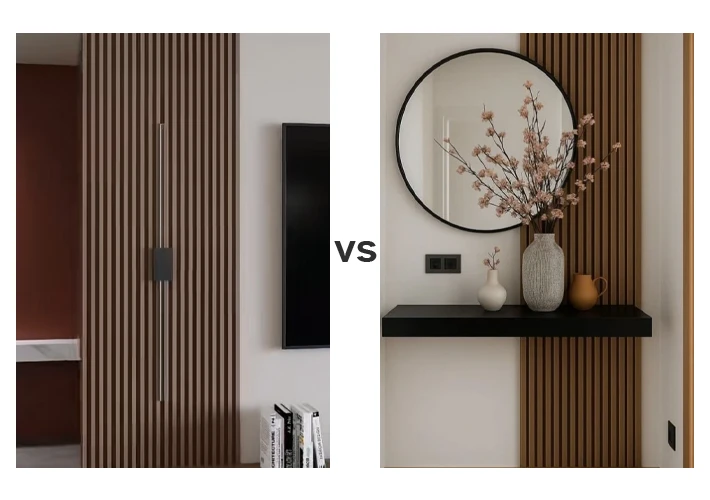
WPC Fluted 3D Wall Panels vs Wood Slat Panels: Which One Should You Choose?
There is no universal winner.
The better product depends on the project’s priorities.
Choose WPC fluted 3D wall panels if you prioritize:
- Moisture resistance
- Low maintenance
- Consistent appearance
- Modern 3D design
- Easy commercial maintenance
- High-volume production
- Humid climate applications
- Competitive B2B pricing
- Consistent supply
- Custom colors and finishes
Choose wood slat panels if you prioritize:
- Natural wood appearance
- Premium timber aesthetics
- Acoustic performance
- Warm interior atmosphere
- Natural material character
- High-end residential or hospitality design
For many B2B projects, WPC is the more practical all-around solution because it balances appearance, durability, maintenance, and production consistency.
Wood slat panels remain an excellent choice when natural wood aesthetics and acoustic performance are central to the project.
The decision should therefore be based on application rather than appearance alone.
Why Choose AesthEdge as Your WPC Wall Panel Supplier?
For importers, wholesalers, and project contractors, choosing the right product is only half of the decision. Choosing the right supplier is equally important.
AesthEdge focuses on decorative wall panel solutions for international B2B customers, with products designed for distributors, contractors, interior designers, developers, and commercial projects.
As a China-based manufacturer, AesthEdge can support customers looking for WPC fluted 3D wall panels with a combination of factory production, product customization, export packaging, and project-oriented service.
Our WPC wall panel solutions can be developed around different market requirements, including:
- Different colors
- Wood-grain finishes
- Multiple surface textures
- Different panel sizes
- Decorative fluted profiles
- OEM packaging
- Private-label requirements
- Wholesale orders
- Project supply
For distributors, product consistency is particularly important. A reliable supply partner should be able to maintain stable specifications across repeat orders, provide samples before bulk production, communicate production schedules clearly, and prepare products for international transportation.
AesthEdge also understands that B2B customers are not simply purchasing wall panels. They are purchasing a product that needs to be easy to sell, easy to install, easy to maintain, and reliable to reorder.
For this reason, when comparing WPC fluted 3D wall panels with wood slat panels, buyers should evaluate the complete supply chain rather than focusing only on the initial material price.
Final Verdict: WPC Fluted 3D Wall Panels or Wood Slat Panels?
The answer is straightforward:
WPC fluted 3D wall panels are generally better for buyers who prioritize moisture resistance, low maintenance, design consistency, durability, and scalable B2B supply.
Wood slat panels are generally better for buyers who prioritize authentic wood aesthetics and acoustic performance.
For humid climates, commercial developments, hotels, restaurants, apartments, retail projects, and large-scale decorative wall applications, WPC offers a strong combination of performance and visual appeal.
For premium interiors, acoustic-focused rooms, executive spaces, and projects where natural timber is a major part of the design concept, wood slat panels can be the better choice.
Ultimately, the best product is the one that matches the project’s environment, design objectives, acoustic requirements, maintenance expectations, budget, and installation method.
For importers and distributors looking for a scalable decorative wall panel solution from China, WPC fluted 3D wall panels are worth serious consideration. With modern wood-grain finishes, dimensional profiles, customizable designs, and efficient factory production, they provide an effective alternative to traditional wood wall systems.
If you are sourcing WPC fluted 3D wall panels for wholesale, distribution, hotel projects, commercial interiors, or private-label business, AesthEdge can provide factory-direct solutions, product samples, customization, and export-oriented packaging.
Contact AesthEdge today to request WPC fluted 3D wall panel samples, specifications, colors, MOQ, and wholesale quotation for your market.