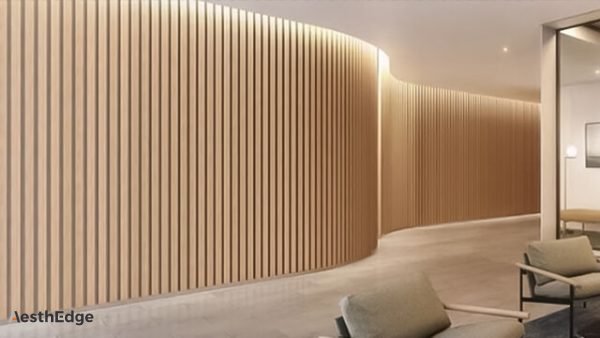
When architects, contractors, distributors, and commercial building material buyers compare acoustic board panels, one of the most important technical specifications to consider is the NRC rating. NRC stands for Noise Reduction Coefficient, and it is commonly used to describe how effectively an acoustic material absorbs sound within a room.
For buyers who are sourcing acoustic board panels from China, understanding NRC is particularly important. A panel with a higher NRC may provide better sound absorption, but NRC alone does not determine whether a product is suitable for an office, hotel, restaurant, conference room, school, recording space, or other commercial environment.
The actual acoustic performance depends on several factors, including panel thickness, material density, surface structure, mounting method, air gaps, room conditions, and the overall acoustic design.
At AesthEdge, we manufacture decorative acoustic wall panels and acoustic board panels in China for international B2B customers. Our acoustic products are developed to combine sound absorption and interior decoration, making them suitable for commercial, hospitality, office, educational, and architectural applications.
This guide explains what the NRC rating means, how it is tested, what NRC levels buyers should consider, and how to choose acoustic board panels for different projects.
What Does NRC Mean for Acoustic Board Panels?
The Noise Reduction Coefficient (NRC) is a single-number rating used to indicate the sound absorption performance of a material.
In simple terms, NRC helps answer the question:
How effectively does this acoustic panel absorb sound rather than allowing sound energy to reflect back into the room?
The NRC value is generally calculated from sound absorption coefficients measured at several standard frequencies, commonly 250 Hz, 500 Hz, 1000 Hz, and 2000 Hz. The resulting number is rounded to the nearest 0.05.
For example, an acoustic board panel may have an NRC rating of:
- NRC 0.30
- NRC 0.40
- NRC 0.50
- NRC 0.60
- NRC 0.70
- NRC 0.80
- NRC 0.90
- NRC 1.00
A higher NRC generally indicates greater sound absorption.
However, NRC should not be interpreted as a simple percentage of all sound that disappears. For example, an NRC of 0.80 does not mean that the panel blocks 80% of all noise. NRC is a standardized sound absorption rating, not a sound transmission loss rating.
This distinction is very important for B2B buyers.
An acoustic panel with a high NRC is primarily designed to control reverberation and reflected sound inside a room. It is different from a soundproofing system designed to prevent sound from passing through a wall, floor, ceiling, or partition.
ASTM International’s ASTM C423 standard covers laboratory measurement of sound absorption and sound absorption coefficients using the reverberation room method. The standard notes that the measured coefficients are used in acoustic design, while practical performance can vary depending on actual room conditions.
Therefore, when purchasing acoustic board panels, buyers should look at NRC together with the complete product construction and installation system.
NRC Rating Examples
The following table provides a general reference for understanding different NRC levels:
| NRC Rating | General Sound Absorption Level | Typical Consideration |
|---|---|---|
| 0.20–0.30 | Low | Decorative surfaces with limited acoustic absorption |
| 0.35–0.45 | Moderate | Basic acoustic improvement |
| 0.50–0.60 | Good | Offices, corridors, commercial interiors |
| 0.65–0.75 | Very Good | Meeting rooms, restaurants, hotels |
| 0.80–0.90 | High | Conference rooms, studios, high-performance spaces |
| 0.95–1.00+ | Very High | Spaces requiring substantial reverberation control |
These ranges are useful for preliminary product selection, but the final decision should be based on laboratory test data and the actual installation configuration.
Some acoustic products can even have measured absorption coefficients above 1.0 at certain frequencies because of the way standardized reverberation-room measurements account for diffraction and apparent absorbing area. ASTM specifically explains this phenomenon in its C423 documentation.
How Is the NRC Rating Tested?
For professional acoustic board panel procurement, it is important to understand where the NRC number comes from.
The most commonly referenced laboratory standard in the United States for this type of measurement is ASTM C423, which covers the measurement of sound absorption in a reverberation room.
During a laboratory test, the acoustic material is placed in a controlled reverberation-room environment. The decay of sound energy is measured with and without the test specimen. The resulting data are used to determine sound absorption coefficients at different frequencies.
The individual frequency results provide more detailed acoustic information than NRC alone.
For example, a test report may show values at:
- 125 Hz
- 250 Hz
- 500 Hz
- 1000 Hz
- 2000 Hz
- 4000 Hz
These values help acoustical engineers understand how the product performs across different frequency ranges.
NRC then provides a convenient single-number summary.
For example, an acoustic panel could have a frequency response similar to:
| Frequency | Sound Absorption Coefficient |
|---|---|
| 250 Hz | 0.30 |
| 500 Hz | 0.65 |
| 1000 Hz | 0.85 |
| 2000 Hz | 0.90 |
The exact NRC calculation should always be taken from the applicable test report rather than estimated from marketing materials.
Why Test Conditions Matter
One important point for importers and project buyers is that the same acoustic material can perform differently depending on how it is installed.
A panel installed directly against a hard wall may produce different acoustic performance from the same panel installed with an air cavity behind it.
Similarly, changes in:
- panel thickness,
- mounting system,
- backing material,
- air gap,
- surface geometry,
- installation density,
- ceiling or wall position,
can affect acoustic absorption.
ASTM notes that laboratory sound absorption measurements are conducted under controlled conditions and that actual spaces can differ because sound fields and room configurations are not identical to laboratory conditions.
This is why professional buyers should ask a manufacturer for the complete acoustic test configuration, rather than looking only at a large NRC number printed on a brochure.

What NRC Rating Should Acoustic Board Panels Have?
There is no single NRC rating that is suitable for every project.
The correct NRC depends on the room size, occupancy, architecture, surface materials, expected noise level, and acoustic objectives.
For many commercial interior applications, acoustic board panels with an NRC around 0.50 to 0.80 can provide useful sound absorption. Projects requiring stronger reverberation control may specify products with NRC values around 0.80 to 1.00 or higher.
For example, a standard office may not require the same acoustic performance as a recording studio.
NRC 0.30–0.40
Panels within this range may provide basic sound absorption.
They can be useful where the main objective is to introduce some acoustic treatment while maintaining a decorative wall finish.
Potential applications include:
- Decorative commercial walls
- Corridors
- Reception areas
- Retail interiors
- Low-noise offices
- Residential common areas
For these projects, aesthetics and cost may be equally important as acoustic performance.
NRC 0.50–0.60
This range provides a stronger level of acoustic absorption and can be appropriate for many commercial spaces.
Typical applications include:
- Open-plan offices
- Restaurants
- Hotel public areas
- Meeting spaces
- Classrooms
- Libraries
- Healthcare interiors
- Commercial showrooms
For B2B projects, this can be an attractive balance between acoustic performance, decorative appearance, and material cost.
NRC 0.65–0.80
Acoustic board panels within this range can provide substantial reverberation control.
They are commonly considered for environments where speech intelligibility and acoustic comfort are important.
Potential applications include:
- Conference rooms
- Training rooms
- Hotel meeting rooms
- Corporate offices
- Restaurants
- Lecture rooms
- Entertainment spaces
- High-end residential developments
NRC 0.85–1.00+
High-NRC acoustic panels are designed for applications where sound absorption is a major part of the room’s acoustic strategy.
Potential applications include:
- Recording rooms
- Podcast studios
- Music rooms
- Professional conference spaces
- Auditoriums
- Cinemas
- Broadcast environments
- High-performance commercial interiors
However, even very high-NRC panels do not automatically make a room soundproof.
This is one of the most common misunderstandings among buyers.
NRC vs Soundproofing: What Is the Difference?
NRC measures sound absorption.
Soundproofing is primarily concerned with reducing sound transmission from one space to another.
These are two different acoustic functions.
Imagine a busy restaurant.
Customers are talking, kitchen equipment is operating, music is playing, and sound is reflecting from the walls, ceiling, floor, and glass surfaces.
If the room has many hard surfaces, sound can continue bouncing around the space. This creates a high level of reverberation and can make conversations difficult to understand.
Installing acoustic board panels with a high NRC can absorb part of this reflected sound and help reduce reverberation.
But if noise from the restaurant needs to be prevented from entering a neighboring hotel room, a simple decorative acoustic panel may not be enough.
That application requires a different strategy involving elements such as:
- Mass
- Wall construction
- Insulation
- Sealing
- Decoupling
- Doors
- Windows
- Partition construction
Therefore:
NRC = sound absorption
STC and similar transmission ratings = sound isolation
An acoustic board panel can improve the acoustic environment inside a room without necessarily preventing sound from passing through the wall.
For B2B buyers, understanding this distinction helps prevent incorrect product specifications and customer complaints after installation.
What Factors Affect the NRC of Acoustic Board Panels?
The NRC rating is influenced by more than the basic material.
Several product and installation factors should be considered when comparing acoustic board panels.
1. Panel Thickness
Thickness is one of the most important factors.
In many porous acoustic materials, increasing thickness provides a longer path for sound energy to interact with the absorbing structure.
This can improve absorption, particularly at lower frequencies.
For example, a thin decorative acoustic board may provide moderate absorption, while a thicker panel or composite construction can provide significantly stronger acoustic performance.
As a result, buyers should compare products at the same thickness rather than comparing NRC values without considering dimensions.
2. Material Structure
Different materials absorb sound in different ways.
Common acoustic board panel constructions include:
- PET acoustic felt
- Polyester fiber
- Mineral fiber
- Fiberglass
- Fabric-wrapped acoustic boards
- Wood acoustic panels with acoustic backing
- Perforated or slotted panels
- Composite acoustic panels
Porous materials can convert part of the sound energy into small amounts of heat through friction as air moves through the material structure.
Perforated and slotted decorative panels can also be engineered to work with acoustic backing materials.
For architects and interior designers, this creates opportunities to combine acoustic performance with decorative finishes.
3. Surface Design
A completely flat panel and a three-dimensional acoustic panel can have different acoustic behavior.
Decorative grooves, slats, perforations, curves, and three-dimensional structures can change the way sound interacts with the surface.
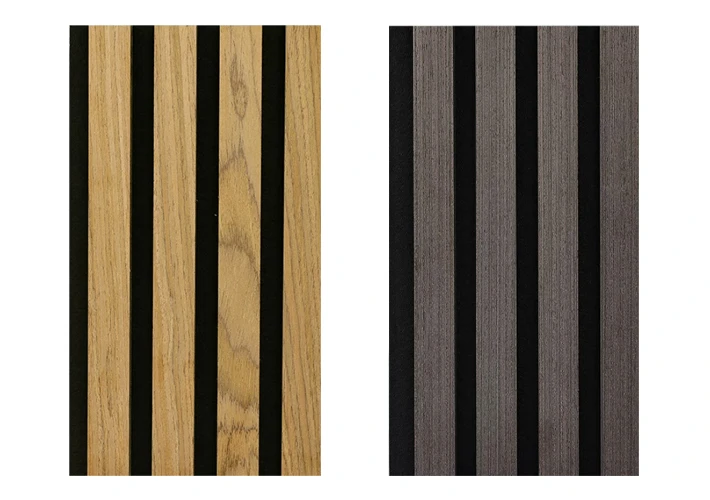
For example, acoustic slat wall panels typically combine a decorative surface with an acoustic backing layer. This allows the wall to function as both an interior feature and an acoustic treatment.
4. Air Gap Behind the Panel
Installation distance can have a significant impact on acoustic performance.
Creating an air cavity behind an acoustic panel can improve absorption at certain frequencies.
This is especially relevant for commercial projects where wall-mounted acoustic systems are installed using framing or battens.
Therefore, an acoustic test report should clearly identify whether the product was tested:
- Directly against the wall
- With an air gap
- With a specific backing
- With a specific mounting system
5. Total Coverage Area
A high-NRC panel does not necessarily solve an acoustic problem if only a very small portion of the room is covered.
The amount of acoustic material installed is also important.
For example, installing acoustic panels on 10% of the wall area will produce a different result from covering 50% or more of the appropriate surfaces.
This means that room acoustic design should consider both:
Product performance + installed coverage
rather than product performance alone.

How Should Buyers Choose Acoustic Board Panels for Different Projects?
For international importers and project contractors, selecting the correct acoustic board panel should involve more than asking for the highest NRC available.
A better purchasing process is to identify the actual application first.
Office Projects
For open-plan offices, the primary objectives are often:
- Reducing reverberation
- Improving speech clarity
- Increasing employee acoustic comfort
- Controlling reflections
- Creating quieter meeting areas
Acoustic wall panels and ceiling treatments can be combined to create a more balanced acoustic environment.
For these projects, products in the medium-to-high NRC range may be appropriate depending on room size and design.
Hotels
Hotels have many acoustic environments, including:
- Hotel lobbies
- Restaurants
- Meeting rooms
- Corridors
- Business centers
- Guest facilities
- Entertainment areas
In hotel projects, appearance is particularly important.
Therefore, hotel acoustic board panels often need to combine:
Acoustic performance + decorative design + durability + easy installation
AesthEdge acoustic panels can be customized for different interior concepts, allowing project designers and material distributors to select different colors, textures, sizes, and surface patterns.
Restaurants
Restaurants often have a combination of hard surfaces such as glass, stone, tile, metal, and finished wood.
These materials can create strong sound reflections.
High-quality acoustic wall or ceiling panels can help reduce reverberation and create a more comfortable dining environment.
For restaurants, acoustic treatment should also consider cleaning requirements, impact resistance, moisture exposure, and overall interior design.
Conference and Meeting Rooms
Speech intelligibility is particularly important in conference rooms.
When excessive reverberation occurs, voices may overlap with reflected sound, making conversations more difficult to understand.
Acoustic board panels with appropriate NRC values can help control these reflections.
The final design should also consider the ceiling, floor, glazing, doors, furniture, and room dimensions.
Schools and Educational Spaces
Classrooms require good speech intelligibility because students need to understand teachers clearly.
Acoustic treatment can help reduce excessive reverberation and background reflections.
Depending on local building requirements, buyers may also need to consider:
- Fire performance
- VOC emissions
- Durability
- Cleanability
- Impact resistance
- Installation method
These requirements should be confirmed according to the destination market and project specification.
Recording and Media Rooms
Recording rooms, podcast studios, and media spaces typically require more detailed acoustic design.
High NRC alone is not enough.
The acoustic engineer may need to consider:
- Low-frequency absorption
- Mid-frequency absorption
- High-frequency absorption
- Diffusion
- Reflection
- Room modes
- Reverberation time
For these applications, buyers should request complete frequency-based test data instead of selecting a product only from its NRC value.
What Should B2B Buyers Ask an Acoustic Panel Manufacturer?
When importing acoustic board panels from China, technical documentation is just as important as price.
Before placing a bulk order, professional buyers should ask the supplier for several key specifications.
1. What Is the Tested NRC?
Do not rely only on phrases such as “excellent sound absorption.”
Ask for the actual NRC value.
2. Which Test Standard Was Used?
ASTM C423 is widely referenced for sound absorption testing in the United States.
The test standard should be clearly stated in the documentation. ASTM currently lists C423-23e1 as an active version of its reverberation-room sound absorption test method.
3. What Was the Mounting Configuration?
This is particularly important.
Ask whether the product was tested:
- Direct mounted
- With a specific air gap
- With acoustic backing
- As an individual panel
- As a complete wall system
4. What Is the Panel Thickness?
NRC values should always be evaluated together with thickness.
A buyer should compare similar product constructions rather than comparing numbers from completely different systems.
5. What Are the Frequency-Based Absorption Coefficients?
For professional architectural projects, the complete frequency response is often more useful than NRC alone.
A test report showing absorption at 125, 250, 500, 1000, 2000, and 4000 Hz provides more information for acoustic planning.
6. What Are the Available Sizes and Finishes?
For distributors and contractors, dimensions can directly affect installation cost and project efficiency.
Common considerations include:
- Panel width
- Panel length
- Thickness
- Weight
- Edge treatment
- Surface finish
- Color
- Custom patterns
7. Can the Factory Provide Samples?
For B2B buyers, samples are strongly recommended before a container order.
A sample allows buyers to evaluate:
- Surface appearance
- Color consistency
- Panel rigidity
- Edge quality
- Installation method
- Acoustic backing
- Packaging
- Overall manufacturing quality
At AesthEdge, we support international buyers with product samples and customized acoustic panel solutions for different commercial projects.
Why Choose AesthEdge Acoustic Board Panels?
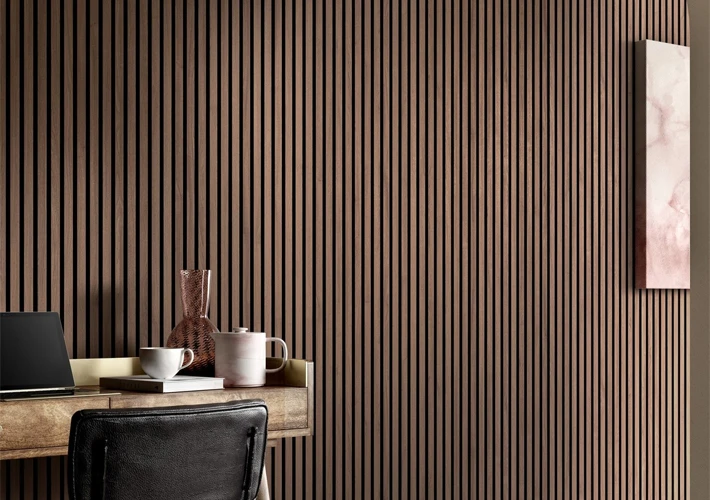
AesthEdge is a China-based manufacturer of architectural and decorative interior materials, serving international B2B customers including importers, distributors, contractors, architects, and project buyers.
Our acoustic product solutions are designed around an important principle:
Acoustic performance should not come at the expense of interior design.
Modern commercial spaces increasingly require both functional and aesthetic materials.
Instead of treating acoustic treatment as an additional technical element, acoustic wall panels can become part of the overall interior design.
AesthEdge acoustic board panels can be developed for applications such as:
- Office interiors
- Hotel lobbies
- Hotel meeting rooms
- Restaurants
- Commercial buildings
- Conference rooms
- Schools
- Showrooms
- Reception areas
- Entertainment spaces
- Residential common areas
For B2B projects, we can support requirements involving product specifications, colors, sizes, surface designs, packaging, and OEM/ODM development.
Our manufacturing approach is particularly suitable for customers who need consistent supply rather than one-time retail purchases.
What Makes a Professional Acoustic Panel Supplier Different?
When comparing Chinese acoustic board panel manufacturers, buyers should look beyond the lowest quotation.
Important supplier capabilities include:
- Stable raw material sourcing
- Consistent production quality
- Technical product specifications
- Acoustic testing documentation
- Sample development
- Custom product development
- Color and finish options
- Export packaging
- Container loading experience
- OEM/ODM capability
- Reliable communication
- Quality inspection before shipment
For distributors, these capabilities can be particularly important because the acoustic product will eventually become part of their own product portfolio.
A supplier that can provide consistent specifications and stable production helps reduce the risks associated with repeat orders.
Frequently Asked Questions About Acoustic Board Panel NRC
Is a higher NRC always better?
Not necessarily.
A higher NRC generally means stronger sound absorption, but the ideal value depends on the room and acoustic objective.
An excessively absorptive room may not always provide the desired acoustic character. Professional projects should balance absorption, reflection, diffusion, and room function.
Is NRC 1.0 the maximum?
NRC is commonly presented on a scale where 1.00 represents very high absorption, but measured sound absorption coefficients at individual frequencies can exceed 1.0 under standardized test conditions.
ASTM explains that diffraction and apparent specimen area can contribute to measured coefficients above unity.
Therefore, an NRC value should be understood as a standardized measurement rather than a literal percentage of sound energy absorbed.
Does NRC mean the panel is soundproof?
No.
NRC measures sound absorption within a room.
It does not directly indicate how much sound can pass through a wall or partition.
For sound isolation, buyers need to consider the construction of the complete wall, partition, floor, ceiling, doors, and other building elements.
What is a good NRC for office acoustic panels?
For many office applications, an NRC around 0.50–0.80 can be a useful starting range.
However, the actual specification should be determined by the room size, occupancy, furniture, ceiling construction, glazing, and acoustic objectives.
Does thicker acoustic board always have a higher NRC?
Not automatically.
Thickness is an important factor, but material composition, density, surface construction, backing, mounting configuration, and air gap also influence acoustic performance.
The best approach is to compare laboratory test results for the actual product construction.
Can acoustic panels be decorative?
Yes.
Modern acoustic panels are available in many decorative configurations, including slatted, grooved, geometric, fabric-covered, PET felt, perforated, and three-dimensional designs.
This makes them suitable for projects where acoustic treatment must also contribute to the visual identity of the interior.
Should I ask for an acoustic test report when buying from China?
Yes.
For commercial projects, an acoustic test report provides much more confidence than a marketing statement.
The report should identify the tested product, thickness, mounting condition, frequency data, test method, and NRC or absorption coefficients.
Can AesthEdge customize acoustic board panels?
Yes.
For B2B customers, customization can include product dimensions, colors, finishes, patterns, packaging, and selected product structures depending on the project and order requirements.
Buyers with larger projects or distribution programs can also discuss OEM/ODM requirements with AesthEdge.
Conclusion
The NRC rating of acoustic board panels is an important specification for evaluating how effectively a product absorbs sound and helps control reverberation within a room.
In general, a higher NRC indicates greater sound absorption, but NRC should never be considered independently.
For professional B2B purchasing, buyers should evaluate:
- NRC rating
- Frequency-based absorption coefficients
- ASTM C423 or applicable test method
- Panel thickness
- Material construction
- Surface structure
- Mounting configuration
- Air gap
- Total coverage area
- Fire and environmental requirements
- Installation system
- Project application
An acoustic panel with NRC 0.80 may be excellent for one project but unnecessary for another. Similarly, a panel with NRC 0.50 may provide an effective and economical solution when installed over an appropriate percentage of the room surface.
For this reason, the best acoustic board panel is not simply the product with the highest NRC. It is the product whose acoustic performance, design, construction, installation method, and commercial requirements match the actual project.
AesthEdge is a China factory supplying decorative acoustic wall panels and acoustic board panels for international B2B customers. If you are an importer, distributor, contractor, architect, or project buyer looking for acoustic panels with customized designs and reliable factory supply, contact AesthEdge for product specifications, samples, and OEM/ODM solutions.