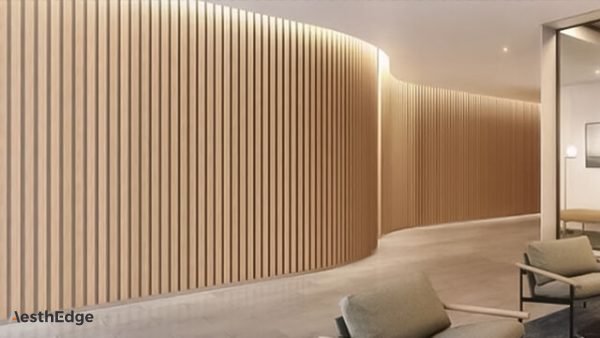
MDF acoustic wall panels are an increasingly popular interior finishing solution for commercial spaces where sound control, modern design, and long-term usability are important. Offices, schools, libraries, conference centers, government buildings, and other public facilities often experience excessive reverberation caused by hard surfaces such as concrete walls, glass partitions, ceramic floors, and metal ceilings. Installing properly designed acoustic wall panels can help reduce reflected sound, improve speech clarity, and create more comfortable indoor environments.
For architects, interior designers, construction contractors, building material importers, and wholesale distributors, selecting MDF acoustic wall panels requires more than comparing surface colors and prices. Buyers need to evaluate acoustic performance, panel dimensions, substrate quality, decorative finishes, fire safety requirements, installation methods, packaging, and the manufacturer’s ability to support bulk commercial orders.
As a professional Chinese building materials supplier, AesthEdge provides decorative wall material solutions for commercial interiors and project-based procurement. Our product-oriented approach focuses on helping international buyers evaluate suitable wall panel specifications, coordinate finishes with interior design schemes, and plan material purchasing for offices, educational facilities, and public buildings.
This guide explains how MDF acoustic wall panels work, where they can be used, which technical specifications matter, and how international buyers can select a reliable manufacturer in China.
What Are MDF Acoustic Wall Panels and How Do They Work?
MDF acoustic wall panels are interior wall finishing products that use medium-density fiberboard (MDF) as a principal structural or decorative component. Many commercial designs combine decorative wood-look slats, an acoustic backing layer, and a mounting system to improve the acoustic characteristics of a room while creating an attractive wall surface.
Unlike ordinary decorative MDF wall panels, acoustic panels are designed with sound absorption in mind. Their performance depends on the complete panel construction, including the facing, gaps between slats, backing material, perforations where applicable, and the air cavity behind the panel.
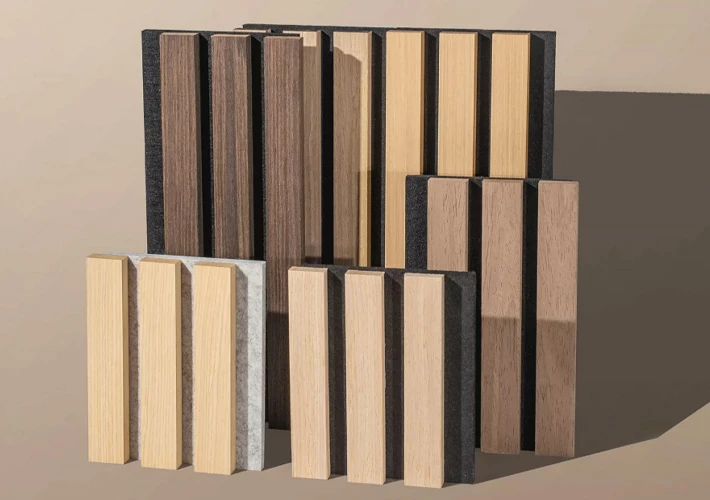
Understanding the Construction of MDF Acoustic Panels
A typical MDF acoustic slat wall panel may include several components.
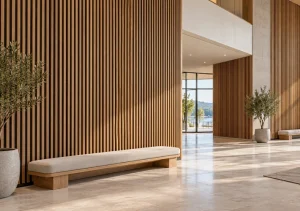
MDF slats or decorative facing: These provide the visible finish and contribute to the overall appearance of the installation. Common styles include natural oak, walnut, teak-inspired wood tones, dark finishes, grey finishes, and contemporary neutral colors.
Acoustic backing: Depending on the product design, a panel may use an acoustic felt layer or another sound-absorbing material behind the MDF slats. This layer helps absorb sound that passes through the openings between the decorative elements.
Mounting structure: Panels may be fixed directly to a suitable substrate or installed over battens or another support structure. The installation method influences the available air cavity and can affect acoustic performance.
Optional decorative surface treatments: Depending on the specification, MDF components may feature melamine finishes, wood-look decorative films, veneers, or other surface treatments intended to achieve the desired visual effect and durability.
Not every MDF acoustic wall panel uses the same construction. Some products feature narrow decorative slats on a felt backing, while others use perforated or grooved MDF boards. Buyers should therefore evaluate the actual product structure rather than assume that all panels offer equivalent acoustic performance.
How MDF Acoustic Wall Panels Improve Room Acoustics
Sound waves travel through a room and reflect from hard surfaces. When multiple reflections persist, the room may sound echoey, conversations may become difficult to understand, and occupants may need to raise their voices.
Acoustic wall panels help manage this reflected sound. In slatted products, sound can enter the spaces between the slats and interact with the absorptive backing. Other acoustic designs use perforations or grooves to allow sound to reach an absorptive layer.
The main objective is usually to reduce excessive reverberation and improve the acoustic comfort of the space.
It is important to distinguish between three different acoustic concepts:
- Sound absorption: Reduces the amount of sound energy reflected back into a room.
- Sound insulation: Limits sound transmission from one room or area to another.
- Sound diffusion: Scatters reflected sound in different directions rather than primarily absorbing it.
MDF acoustic wall panels are generally selected for their sound absorption and decorative benefits. They should not automatically be treated as soundproofing products. If a project requires strong separation between offices, classrooms, meeting rooms, or adjacent properties, the wall assembly may also need suitable mass, airtightness, insulation, and other sound-control measures.
MDF Acoustic Panels vs. Ordinary MDF Decorative Panels
Although both products may use MDF, their intended functions are different.
| Comparison | MDF acoustic wall panels | Ordinary MDF decorative wall panels |
|---|---|---|
| Primary purpose | Interior decoration and sound absorption | Interior decoration |
| Typical construction | Slats, grooves, perforations, or other acoustic designs with backing | Solid decorative boards or profiled panels |
| Sound absorption | Depends on the complete acoustic assembly | Usually limited unless specifically engineered for acoustics |
| Common applications | Offices, classrooms, meeting rooms, libraries, public interiors | Feature walls, corridors, reception areas, retail interiors |
| Performance evaluation | Acoustic test results and installation details | Surface quality, dimensions, durability, and appearance |
For commercial buyers, the key question is whether the product has verified acoustic performance suitable for the intended room. A decorative panel that resembles an acoustic slat panel does not necessarily deliver the same sound absorption.
Why Offices, Schools, and Public Buildings Need MDF Acoustic Wall Panels
Commercial and institutional interiors often combine large open spaces, hard finishes, high occupancy, and frequent conversations. These conditions can create acoustic problems even when the architecture and furniture are visually appealing.
MDF acoustic wall panels offer a way to integrate sound absorption into the interior design without relying exclusively on suspended ceiling systems or bulky acoustic partitions.
MDF Acoustic Wall Panels for Modern Offices
Modern workplaces commonly include open-plan workstations, collaborative areas, meeting rooms, reception spaces, and employee break areas. While open layouts can encourage communication, they may also allow conversations and other sounds to travel across the workspace.
Installing acoustic wall panels in selected locations can help reduce reflections and improve the perceived acoustic comfort of the office.
Open-plan offices
Open offices often have long sightlines, glass partitions, hard floors, and limited enclosed wall surfaces. Decorative MDF acoustic slat panels can be installed on selected walls to introduce sound-absorbing surfaces without changing the basic layout.
They are particularly useful as part of a coordinated acoustic strategy that may also include ceiling absorbers, acoustic screens, carpets, and upholstered furniture.
Conference and meeting rooms
Meeting rooms require clear speech for face-to-face discussions, video conferences, presentations, and negotiations. Excessive reverberation can make speech less intelligible, particularly when several people speak or when microphones and loudspeakers are used.
Acoustic wall panels can be positioned on suitable wall areas to reduce reflections. The correct quantity and placement should be based on room dimensions, existing finishes, the number of occupants, and the acoustic target.
Reception areas and executive offices
Reception spaces establish the visual identity of a business. MDF acoustic panels can combine a professional wood-look finish with an acoustic function, making them suitable for reception backdrops, waiting areas, and selected executive office walls.
For these applications, buyers may prioritize consistent color, clean edges, concealed or coordinated fixings, and compatibility with lighting and signage.
Shared workspaces and breakout areas
Collaborative spaces frequently experience overlapping conversations. Acoustic wall finishes can complement furniture and ceiling treatments to create a more balanced environment.
However, panels alone may not prevent sound from traveling between workstations. Buyers should consider the full acoustic design when privacy or speech confidentiality is a requirement.
MDF Acoustic Wall Panels for Schools and Educational Facilities
Schools and educational buildings require acoustic conditions that support communication, concentration, and daily classroom activities. Students must be able to hear teachers clearly, while teachers need to communicate without constantly raising their voices.
MDF acoustic wall panels can contribute to more suitable room acoustics when their performance, safety characteristics, and installation details meet the project’s requirements.
Classrooms
In classrooms, hard wall and ceiling surfaces can create reverberation that interferes with speech. This is particularly important for younger students, language-learning activities, and situations in which teachers speak from different positions in the room.
Acoustic wall panels can be installed on appropriate wall sections to reduce reflected sound. The final design should consider classroom volume, ceiling height, student occupancy, existing acoustic finishes, and applicable educational building standards.
Libraries and study rooms
Libraries need a comfortable acoustic environment for reading, research, and quiet study. MDF acoustic slat panels can provide a warm, understated decorative finish while contributing to sound absorption.
Designers may combine them with bookshelves, soft seating, acoustic ceiling products, and other interior elements to balance sound control with the visual identity of the library.
Lecture rooms and training centers
Lecture rooms often contain a speaker, an audience, presentation equipment, and reflective surfaces. Acoustic treatment can improve the listening environment, although larger rooms may require a more detailed acoustic design than wall panels alone can provide.
Panel placement should be coordinated with the room’s geometry, loudspeaker locations, and existing finishes.
Corridors and student common areas
School corridors, entrance halls, and student gathering areas can become noisy during breaks and class changes. Decorative acoustic wall panels may help manage reflections in suitable locations.
For high-traffic educational environments, buyers should also assess surface durability, edge protection, cleaning requirements, mounting security, and resistance to accidental impacts.
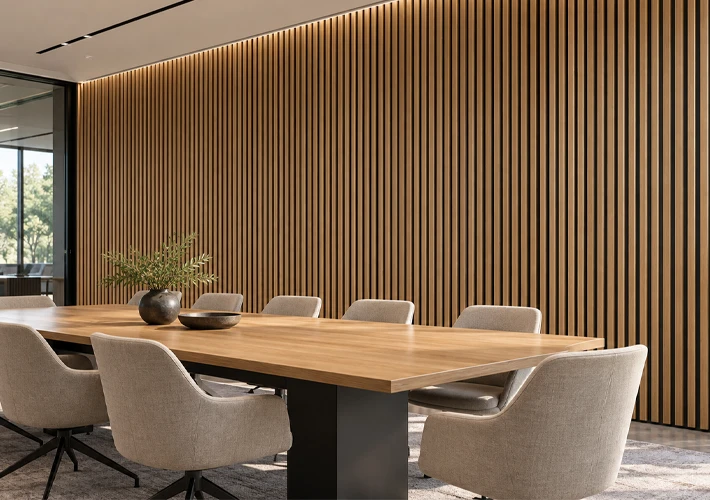
MDF Acoustic Wall Panels for Public Buildings
Public buildings serve diverse groups of users and often include a combination of open circulation areas, waiting zones, offices, meeting rooms, and large communal spaces.
Potential applications include:
- Government offices: Reception counters, administrative offices, consultation rooms, and meeting spaces.
- Libraries and cultural centers: Reading rooms, study zones, seminar rooms, and community areas.
- Hospitals and healthcare administration areas: Selected waiting areas, administrative offices, and staff meeting rooms, subject to applicable hygiene and fire requirements.
- Hotels and conference facilities: Meeting rooms, business centers, conference pre-function spaces, and selected lobby walls.
- Transport and civic buildings: Administrative areas, waiting rooms, and other interior spaces where the specified products meet relevant public-building requirements.
- Community centers: Multipurpose rooms, activity areas, and meeting spaces.
For these projects, aesthetic consistency is only one purchasing consideration. Fire performance, durability, maintenance, installation safety, and compliance with local building regulations may be equally important.
In healthcare, food-service, and other hygiene-sensitive environments, conventional MDF acoustic panels may not be appropriate for every location. Buyers should verify cleaning compatibility, moisture conditions, and the specific regulatory requirements before specifying a product.
Key Specifications Buyers Should Evaluate Before Ordering
When purchasing MDF acoustic wall panels for a commercial project, buyers should establish a clear technical specification before comparing quotations from manufacturers.
The most important considerations include acoustic performance, panel dimensions, MDF quality, backing materials, surface finish, fire requirements, and installation conditions.
Acoustic Absorption and NRC Ratings
The Noise Reduction Coefficient (NRC) is a commonly used single-number indicator of sound absorption performance in certain markets. It is calculated from absorption measurements at selected frequencies and rounded according to the applicable testing standard.
An NRC value should always be interpreted alongside the test method, sample construction, mounting arrangement, and test report.
For example, a slatted panel tested with an air cavity behind it may produce a different result when installed directly against a solid wall. The backing material, slat spacing, panel thickness, and cavity depth can also influence performance.
Buyers should request the following information:
- The reported NRC or other applicable sound absorption rating.
- The test standard and laboratory report.
- The tested panel dimensions and construction.
- The mounting arrangement and air cavity depth.
- The tested frequency range or absorption coefficients, where available.
Do not rely solely on a supplier’s general statement that a product is highly sound-absorbing. The test result should correspond to the product and installation method specified for the project.
NRC is not a sound transmission loss rating. A high absorption value does not, by itself, prove that a panel will prevent conversations from passing through a wall.
MDF Thickness and Panel Dimensions
Panel dimensions affect material planning, installation labor, joint placement, and transportation efficiency.
Common decorative acoustic panel formats include tall slatted panels, modular rectangular boards, and customized sizes for particular projects. Dimensions such as 2400 mm or 2700 mm in length may be available from some suppliers, but buyers should confirm the actual production range rather than assume a universal standard.
Important dimensional details include:
| Specification | What buyers should confirm |
|---|---|
| Overall panel size | Length, width, and total thickness |
| MDF component thickness | Thickness of the decorative slats or acoustic board |
| Slat dimensions | Width, depth, and spacing |
| Backing material | Material type, thickness, and coverage |
| Edge details | Finished edges, exposed backing, and joint design |
| Dimensional tolerance | Permitted variation in length, width, and thickness |
| Installation clearance | Required expansion gaps and perimeter details |
Larger panels can reduce the number of joints and installation steps, but they may also increase handling difficulty and packaging requirements. The best format depends on the project layout, wall height, access conditions, and installer capabilities.
MDF Density, Quality, and Stability
Medium-density fiberboard is manufactured from wood fibers bonded together under controlled conditions. Its quality can vary depending on fiber preparation, resin system, pressing conditions, density profile, and manufacturing controls.
For commercial wall panels, buyers should assess whether the MDF substrate is appropriate for the intended indoor environment and whether the finished product maintains acceptable dimensional stability.
Key considerations include:
- Consistent thickness and density.
- Surface smoothness and suitability for the selected finish.
- Edge quality and resistance to chipping during normal handling.
- Bonding quality between the MDF and decorative surface.
- Suitability for the expected humidity and temperature conditions.
- Relevant emissions documentation for the destination market.
MDF is a wood-based product and should not be treated as waterproof simply because it has a decorative coating. Persistent moisture, water leakage, or unsuitable humidity conditions may cause swelling, deformation, or finish damage.
Where moisture exposure is expected, buyers should discuss the product’s limitations with the manufacturer and consider a more suitable substrate or a different wall-finishing system.
Acoustic Backing Materials
The backing layer is an important component of many MDF acoustic slat panels. It may consist of acoustic felt or another engineered sound-absorbing material.
Buyers should confirm its thickness, composition, attachment method, and acoustic test documentation. The backing should be compatible with the panel design and the installation environment.
Where projects require specific fire performance, the backing material must also be considered as part of the tested or approved assembly. A fire classification for one component does not automatically establish the classification of the entire panel system.
Fire Safety and Environmental Requirements
Fire safety requirements vary by country, building type, occupancy, and installation location. Schools, healthcare facilities, government buildings, and large commercial interiors may be subject to specific restrictions on interior wall finishes.
Before approving a product, buyers should identify the applicable local code and request the relevant test reports or certifications.
Depending on the market and project specification, the required evidence may include:
- Reaction-to-fire classification or another locally accepted fire test.
- Formaldehyde emissions documentation for the MDF substrate.
- Indoor air quality or VOC-related documentation where required.
- Product safety information and installation instructions.
- Documentation for the backing material, adhesives, and decorative finish.
Do not assume that an ordinary MDF acoustic panel meets a particular fire class or emissions limit without supporting documentation. If a project requires a tested assembly, the exact combination of panel, backing, adhesive, mounting method, and air cavity may need to match the approved configuration.
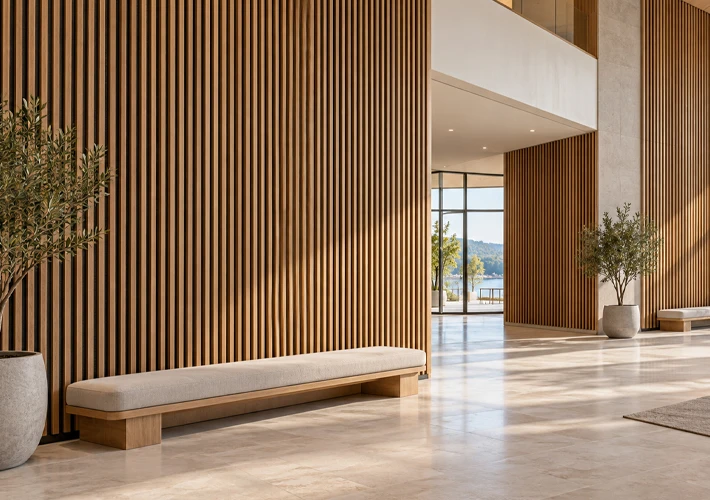
Design Options and Finishes for Commercial Interiors
MDF acoustic wall panels are popular partly because they can integrate acoustic treatment into a decorative wall scheme. For commercial buyers, the design should support the architectural concept while remaining practical for procurement, installation, and maintenance.
AesthEdge focuses on decorative wall material solutions for commercial interiors, where buyers may need to coordinate wall finishes across reception areas, corridors, meeting rooms, classrooms, and other project spaces.
Wood-Look MDF Acoustic Slat Panels
Wood-look slat panels are a common choice for contemporary commercial interiors. The vertical or horizontal slat arrangement creates visual rhythm and can make a feature wall appear more structured.
Popular finish directions include:
Natural oak: Suitable for modern offices, libraries, educational interiors, and collaborative spaces seeking a light, natural appearance.
Walnut and darker wood tones: Often selected for executive meeting rooms, hotel business centers, conference facilities, and formal reception areas.
Teak-inspired finishes: Useful when the interior design calls for a warm, refined wood appearance.
Grey and neutral finishes: Compatible with minimalist offices, contemporary public interiors, and commercial spaces using metal, glass, or concrete-look materials.
The final finish should be selected with reference to actual samples because color representation on screens can differ from the finished product.
Vertical Slats vs. Horizontal Slats
Vertical slats can visually emphasize wall height and create a clean architectural effect. They are often used behind reception desks, in meeting rooms, and on selected feature walls.
Horizontal slats can emphasize wall width and work well in corridors, waiting areas, and long office walls.
The orientation also affects joint planning and installation details. Buyers should consider the wall dimensions, panel format, lighting direction, and the position of doors, sockets, access panels, and other building services.
Coordinating Acoustic Panels with Other Wall Materials
Acoustic wall panels do not need to cover every wall. In many commercial projects, a mixed-material design offers better control over cost and appearance.
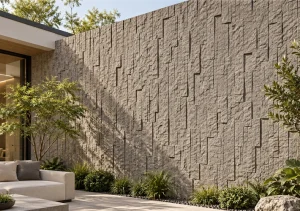
For example, an office reception wall may combine acoustic MDF slats with a stone-look decorative panel, while a meeting room may use acoustic panels on selected reflective surfaces and a different finish elsewhere.
A school library may pair wood-look slat panels with painted walls and shelving. A conference center may coordinate the panels with carpet, upholstered seating, and ceiling absorbers.
When combining different materials, buyers should check that their thicknesses, edges, fixing methods, and surface finishes work together. The design should also allow access to building services and maintenance points.
Custom Colors, Sizes, and Project Matching
Commercial developments often require consistent finishes across multiple rooms or buildings. Importers, contractors, and project suppliers may therefore need customized dimensions, coordinated color schemes, or special packaging.
Before requesting a quotation, prepare a specification sheet that includes:
- Project type and intended application.
- Required panel dimensions and total quantity.
- Preferred finish, color reference, or physical sample.
- Acoustic performance target.
- Fire classification and emissions requirements.
- Installation method and substrate conditions.
- Delivery destination and expected schedule.
A detailed specification reduces misunderstandings between the buyer, manufacturer, designer, and installer. It also makes quotations easier to compare on an equivalent basis.
Installation, Maintenance, and Long-Term Performance
Even a well-manufactured MDF acoustic wall panel may underperform if it is installed incorrectly or used in an unsuitable environment. Installation planning should therefore be considered part of product selection rather than a separate issue addressed only after delivery.
Preparing the Wall Surface
Before installation, the wall should be inspected for flatness, stability, moisture, and any existing defects. The installer should verify that the supporting substrate and fixing method can safely carry the weight of the panels.
Electrical outlets, switches, access panels, fire equipment, and other building services must be considered before fixing the panels in place.
For projects involving large quantities of panels, the installation team should review a layout drawing before work begins. This helps control alignment, joint placement, material waste, and the visual continuity of the finished wall.
Choosing the Right Mounting Method
Depending on the panel design and project requirements, installation may involve direct mechanical fixing, suitable adhesive systems, battens, or a manufacturer-recommended mounting arrangement.
Each method has different implications for structural support, acoustic performance, installation speed, and future removal.
Direct fixing: May reduce the space required behind the panels, but the final acoustic result must match the conditions under which the product was tested.
Batten installation: Can create an air cavity behind the panel and may improve absorption at certain frequencies, depending on the complete assembly. It also increases the depth of the finished wall and requires careful alignment.
Adhesive installation: May be suitable for certain products and substrates, but the adhesive must be compatible with the panel backing, wall surface, and relevant fire requirements.
Buyers should follow the approved installation instructions and avoid assuming that different mounting systems will deliver identical acoustic results.
Cutting and Edge Finishing
Commercial projects often require panels to be cut around corners, doors, sockets, and other architectural features.
The installation team should use suitable tools and cutting procedures to reduce chipping and damage. Exposed edges may require appropriate finishing, depending on the product design.
Cutting acoustic panels may also expose the backing layer or alter the slat arrangement. The project specification should explain how edges, corners, transitions, and cutouts are to be completed.
For large projects, it is useful to agree on a sample installation or a mock-up before proceeding with the full order.
Cleaning and Routine Maintenance
Maintenance requirements depend on the MDF surface finish and backing material.
In general, routine cleaning should use a soft cloth or an appropriate vacuum attachment. Cleaning products should be compatible with the decorative surface and should not introduce excessive moisture.
Avoid soaking MDF panels or using harsh chemicals unless the manufacturer specifically confirms that the surface can tolerate them.
In schools and high-traffic public areas, the maintenance plan should also address accidental impacts, scratches, damaged edges, and the replacement of individual panels if necessary.
Where a panel uses exposed acoustic felt, the cleaning procedure may differ from that used for the MDF facing. Buyers should obtain care instructions for the complete product.
Moisture, Ventilation, and Environmental Conditions
MDF acoustic panels are generally intended for appropriate interior environments. They should not be specified for persistently wet locations unless the manufacturer confirms that the exact product is suitable.
Buildings with high indoor humidity, condensation risks, or a history of water leakage require particular attention. Before installation, the source of moisture should be addressed and the substrate allowed to reach appropriate conditions.
Long-term performance depends on selecting the right product, controlling the installation environment, and maintaining the panel according to the manufacturer’s instructions.

How to Buy MDF Acoustic Wall Panels from a Chinese Manufacturer
For international B2B buyers, sourcing MDF acoustic wall panels from China can provide access to a broad range of decorative finishes, panel formats, and production options. However, the quality of the purchasing decision depends on supplier verification, specification control, sample approval, quality inspection, and logistics planning.
AesthEdge works with commercial interior material requirements and supports buyers who need to evaluate decorative wall panel solutions for wholesale supply and building projects.
Define Your Project Requirements Before Requesting Quotes
A quotation is only useful when the products being compared have equivalent specifications.
Before contacting a manufacturer, establish the approximate wall area, required panel format, preferred finish, installation method, and destination-market requirements.
For acoustic projects, the required absorption performance should be identified early. If a consultant has specified a particular NRC value or an equivalent acoustic criterion, provide the test requirement and mounting conditions to the supplier.
For schools and public buildings, identify applicable fire and indoor emissions requirements before approving a product. This helps prevent the purchase of panels that cannot be accepted by the project consultant or local authorities.
Evaluate Manufacturer Capabilities
A reliable manufacturer or supplier should be able to explain the product structure, available dimensions, finish options, packaging method, and applicable quality documentation.
Buyers should evaluate the supplier using evidence rather than marketing claims alone.
Useful questions include:
- What is the exact construction of the MDF acoustic wall panel?
- Which MDF substrate and backing materials are used?
- What dimensions, thicknesses, finishes, and colors are available?
- Are acoustic test reports available for the specified construction?
- Which fire and emissions documents are available for the target market?
- Can the supplier provide samples before bulk production?
- What quality checks are performed during manufacturing?
- How are panels protected against scratches, broken edges, and deformation during transport?
- What are the production lead time, minimum order quantity, and available customization options?
- Can the supplier support repeat orders with consistent finishes and specifications?
These questions help distinguish a supplier that can support project procurement from one that only offers a generic decorative product.
Request Samples and Confirm Technical Documentation
Physical samples are important because wood-look finishes, surface textures, slat proportions, and colors can appear different from online images.
For larger orders, buyers should approve a sample against the intended project design and retain a reference for comparison during production and delivery inspection.
Where acoustic performance is a key requirement, sample approval should be accompanied by the appropriate test documentation. A small decorative sample can confirm appearance, but it cannot independently establish the acoustic performance of the complete installation.
For regulated projects, the buyer should also confirm that the supplied product matches the materials and configuration covered by the submitted test reports.
Compare Total Project Cost, Not Just Unit Price
The lowest quoted price does not necessarily represent the lowest total installed cost.
A meaningful comparison should account for the following:
| Cost factor | Why it matters |
|---|---|
| Panel unit price | Establishes the basic material cost |
| Backing and mounting system | May be included or priced separately |
| Custom finishes | Can affect production cost and lead time |
| Packaging | Protects panels during handling and shipping |
| Freight and import charges | Depend on shipment volume, destination, and trade terms |
| Installation labor | Influenced by panel dimensions and mounting complexity |
| Cutting waste | Depends on the room layout and panel format |
| Replacement materials | Important for future maintenance and repeat procurement |
For international shipments, buyers should confirm the quotation basis, currency, payment terms, production schedule, packaging specifications, and delivery responsibilities.
Freight costs and import requirements vary by destination, shipment size, and current logistics conditions. They should be calculated for the actual order rather than estimated from the panel price alone.
Production Quality Control and Packaging
Before mass production, the supplier and buyer should agree on acceptable tolerances, surface quality, finish consistency, and packaging requirements.
Relevant inspection points may include:
- Panel length, width, and thickness.
- Slat alignment and spacing.
- Surface defects, scratches, and color variation.
- Bonding between the MDF and backing.
- Edge quality and visible damage.
- Quantity and labeling accuracy.
- Carton protection and shipment marking.
For large projects, pre-shipment inspection can help identify issues before the goods leave the factory. The inspection scope should be agreed in advance and should reflect the project’s specifications.
Packaging is especially important for decorative MDF panels because surface scratches, crushed corners, and moisture exposure during transportation can create additional costs at the destination.
Plan Lead Time and Repeat Orders
Commercial projects often have fixed installation schedules. Buyers should therefore confirm material availability, sample approval deadlines, production lead time, and shipping arrangements before placing an order.
Customized colors, special dimensions, or non-standard backing materials may require additional preparation.
For phased developments or projects with multiple buildings, it is also useful to establish a process for retaining finish references and checking consistency between batches. This can reduce the risk of visible differences between panels purchased at different times.
Why Work with AesthEdge?
AesthEdge is a China-based building materials brand serving international commercial material requirements. For buyers evaluating MDF acoustic wall panels and related decorative finishes, our approach is to focus on practical product selection, finish coordination, and project-oriented purchasing discussions.
For office fit-outs, educational facilities, and public building projects, buyers should communicate their technical specifications and project requirements clearly so the appropriate product options can be evaluated.
Our commercial material discussions can cover matters such as:
- Product selection based on the intended application.
- Decorative finish and color coordination.
- Panel dimensions and customization requirements, subject to product availability.
- Sample evaluation and specification confirmation.
- Bulk-order planning and export packaging coordination.
- Product documentation and installation information available for the selected specification.
The exact acoustic performance, fire classification, emissions characteristics, dimensions, minimum order quantity, and production lead time must be confirmed for the product being quoted. Buyers should request the relevant documentation before making a final project approval.
For importers, wholesalers, contractors, and project procurement teams, working with a supplier that understands both decorative finishes and specification requirements can make the sourcing process more structured and reduce avoidable communication issues.
Frequently Asked Questions About MDF Acoustic Wall Panels
Are MDF acoustic wall panels suitable for offices?
Yes. MDF acoustic wall panels can be suitable for open-plan offices, meeting rooms, reception areas, collaborative spaces, and selected executive offices. Their main acoustic benefit is the reduction of reflected sound, which can improve room comfort and speech clarity when the panel design and placement are appropriate.
The amount of treatment required depends on the room size, occupancy, existing finishes, and acoustic objectives. Panels should be selected using relevant test results rather than appearance alone.
Can MDF acoustic panels be used in schools?
MDF acoustic panels can be used in suitable educational interiors, including classrooms, libraries, training rooms, and selected common areas, provided that the product meets the project’s acoustic, fire safety, emissions, durability, and installation requirements.
School projects may be subject to specific regulations. Buyers should verify the required classifications and documentation with the architect, consultant, or relevant authority before ordering.
Do MDF acoustic wall panels soundproof a room?
No. Acoustic absorption and soundproofing are different functions.
MDF acoustic wall panels can reduce sound reflections inside a room, but they do not automatically prevent sound from passing through walls, doors, floors, or ceilings.
For meeting rooms or offices requiring speech privacy, additional measures may be necessary, such as improved wall construction, acoustic seals, insulated partitions, and appropriately rated doors.
What is a good NRC rating for MDF acoustic wall panels?
There is no single NRC value that is ideal for every room. The appropriate target depends on room volume, the intended use, existing acoustic treatment, and the applicable project specification.
Buyers should review the full acoustic test report, including the tested construction and mounting conditions. A panel tested with an air cavity may perform differently when installed directly against a wall.
The architect or acoustic consultant should establish the required performance for projects with formal acoustic criteria.
What sizes are available for MDF acoustic wall panels?
Available sizes vary by manufacturer and product series. Some decorative slat panels are supplied in tall modular formats, while other products can be manufactured or cut to project-specific dimensions.
Buyers should confirm overall panel size, thickness, slat spacing, edge details, tolerances, and packing dimensions before ordering. The panel format should be coordinated with the room layout to reduce unnecessary cutting and waste.
Are MDF acoustic wall panels environmentally friendly?
Environmental performance depends on the MDF substrate, resin system, decorative finish, backing material, manufacturing process, and relevant product documentation.
Buyers may need formaldehyde emissions reports, VOC-related information, or other environmental documentation depending on the destination market and project requirements.
A product should not be described as emission-free or environmentally certified without appropriate evidence. Request documentation for the actual product being supplied rather than relying on general claims about MDF or decorative panels.
Can MDF acoustic panels be customized for commercial projects?
Customization may be possible depending on the manufacturer’s product range, equipment, material availability, and order quantity.
Potential options include different finishes, slat dimensions, panel formats, and coordinated colors. Buyers should confirm whether the requested customization affects acoustic performance, fire documentation, minimum order quantity, or production lead time.
Any customized construction intended for a regulated building should be reviewed against the project’s technical requirements.
How should MDF acoustic wall panels be maintained?
Maintenance generally involves routine dust removal and careful cleaning with a soft cloth or suitable vacuum attachment. Excessive moisture and incompatible cleaning chemicals should be avoided.
The appropriate cleaning method depends on the surface finish and backing material. High-traffic spaces may also require periodic inspection for damaged edges, loose fixings, or surface scratches.
How do I calculate the quantity required for a project?
Start by calculating the net wall area to be covered. Subtract openings where panels will not be installed, then account for panel dimensions, layout, cutting waste, and any additional material required for future repairs.
For a rectangular wall, the basic area calculation is:
Wall area = wall length × wall height
For example, a wall measuring 12 meters long and 3 meters high has a gross area of 36 square meters. If doors or other openings occupy 4 square meters, the net area is 32 square meters before adding cutting allowance.
The final quantity should be calculated using the actual panel dimensions and layout. The necessary allowance depends on the number of corners, the pattern, and the installation design; a universal waste percentage is not appropriate for every project.
What should I ask a Chinese MDF acoustic wall panel supplier before ordering?
Ask about the panel structure, MDF quality, backing materials, available dimensions, decorative finishes, acoustic test reports, fire requirements, emissions documentation, installation instructions, quality control, packaging, lead time, and order terms.
For large projects, request samples and agree on the technical specification before mass production. If acoustic performance is essential, ensure that the test report covers the relevant product construction and mounting arrangement.
Conclusion: Choose MDF Acoustic Wall Panels Based on Performance and Project Requirements
MDF acoustic wall panels offer a practical way to combine decorative wall finishes with sound absorption in offices, schools, libraries, meeting rooms, and selected public buildings. Their wood-look surfaces and modular formats make them suitable for a wide range of contemporary commercial interiors.
However, successful specification requires more than choosing an attractive finish. Buyers should evaluate acoustic test results, panel construction, dimensions, MDF quality, fire safety, emissions documentation, installation methods, maintenance requirements, and the conditions in which the panels will be used.
For international importers, wholesalers, architects, and construction contractors, a well-defined product specification is the foundation of a successful bulk purchase. Sample approval, clear technical documentation, production quality control, and suitable export packaging can help reduce project risks and improve consistency across installations.
AesthEdge supports commercial building material sourcing from China, with an emphasis on decorative wall material solutions and project-oriented purchasing requirements. If you are planning an office renovation, school construction project, or public building fit-out, prepare your required dimensions, finish preferences, acoustic targets, and destination-market standards before requesting a quotation.
Contact AesthEdge to discuss suitable decorative wall panel options, request product information, and evaluate the specifications required for your next commercial interior project.