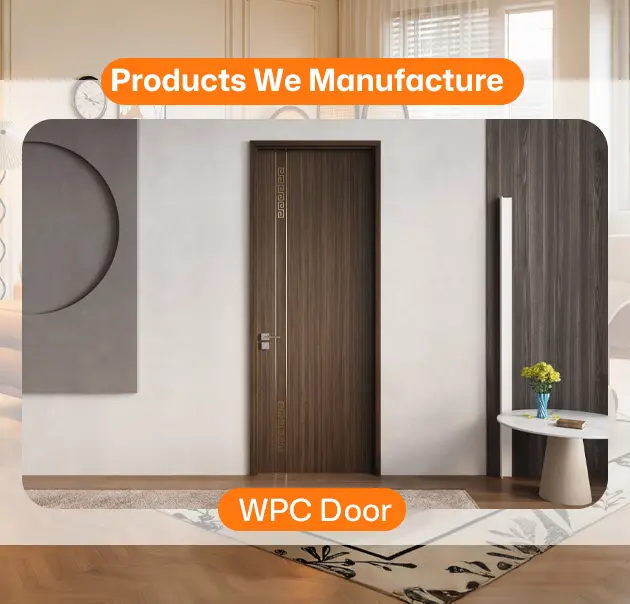
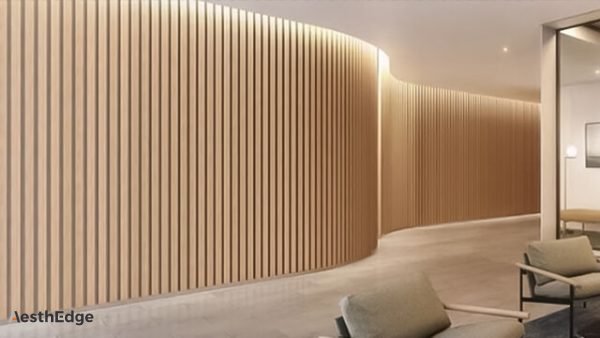
Choosing the right WPC wall panel supplier is one of the most important decisions for importers, distributors, wholesalers, contractors, interior designers, and building material companies. While many suppliers can offer competitive prices, not every supplier can provide consistent quality, reliable delivery, customization, technical support, and long-term business cooperation.
WPC wall panels have become increasingly popular in residential, commercial, hospitality, retail, and office projects because they combine decorative appeal with practical performance. Depending on the product structure and formulation, WPC panels can offer moisture resistance, dimensional stability, low maintenance, attractive wood-like textures, and flexible design options.
For B2B buyers, however, purchasing WPC wall panels is not simply about finding the lowest quotation. A supplier that offers a low initial price but delivers inconsistent colors, poor surface finishing, weak packaging, or delayed orders can ultimately cost much more.
This guide explains how to choose the best WPC wall panel supplier for your business, with a particular focus on factory capability, product quality, certifications, production capacity, OEM/ODM services, pricing, export experience, and after-sales support.
Why Choosing the Right WPC Wall Panel Supplier Matters
The supplier you choose directly affects your product quality, profit margin, delivery schedule, customer satisfaction, and brand reputation.
For a distributor, for example, a small difference in panel quality can become a major issue when selling thousands of square meters to contractors or retailers. Problems such as color variation, surface peeling, warping, dimensional inconsistency, or damaged packaging may lead to complaints, replacements, and additional shipping costs.
A professional WPC wall panel manufacturer should therefore be evaluated from several dimensions rather than price alone.
Key factors include:
- Manufacturing capability
- Raw material quality
- Product consistency
- Quality control
- Certifications and testing
- Production capacity
- MOQ and pricing
- Lead time
- OEM and ODM capability
- Export experience
- Packaging and logistics
- Technical support
- After-sales service
Current industry sourcing guides also emphasize verifying whether a supplier is a genuine manufacturer, checking its production and QC systems, reviewing certifications, requesting samples, and assessing export experience before committing to large orders.
For this reason, the best WPC wall panel supplier is not necessarily the cheapest supplier. It is the supplier that provides the best overall value and the lowest long-term sourcing risk.
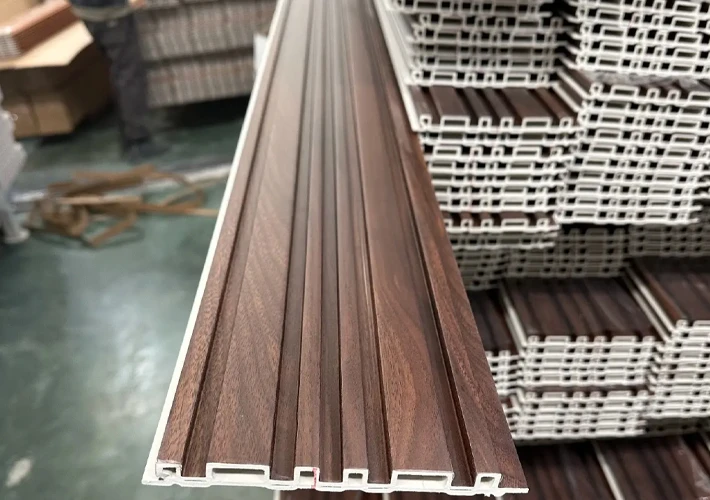
Verify That the Supplier Is a Real WPC Wall Panel Manufacturer
The first step is determining whether you are working directly with a manufacturer or with a trading company.
Trading companies are not necessarily unreliable. In some cases, they can provide useful sourcing services and flexible quantities. However, if your business requires long-term volume purchasing, customized products, private labeling, or strict quality control, direct cooperation with a factory can provide greater control over production.
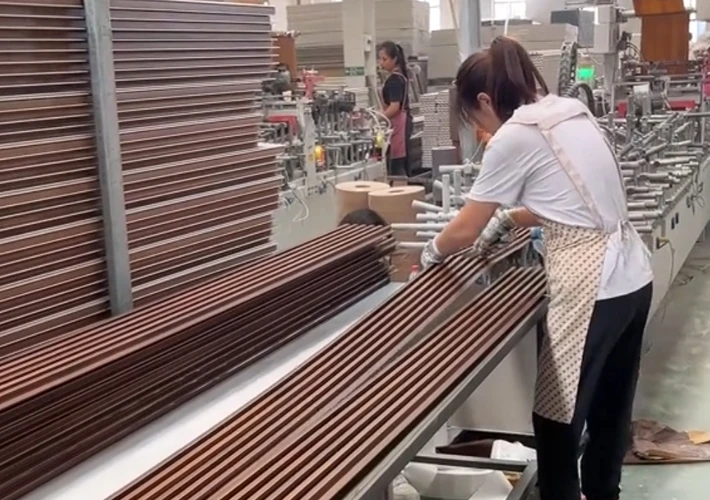
A genuine WPC wall panel manufacturer should be able to clearly explain its production process and provide evidence of its manufacturing capabilities.
Look for:
- Extrusion production lines
- Raw material mixing equipment
- Surface treatment or lamination equipment
- Cutting and finishing equipment
- Quality inspection procedures
- Finished-product warehouses
- Packaging facilities
- Container loading areas
You can also request a live factory video tour. Instead of relying only on factory photos, ask the supplier to show production lines operating in real time.
A useful factory verification process should include:
Step 1: Verify the company information
Check the company registration, manufacturing scope, factory address, and years of operation.
Step 2: Request a video factory tour
Ask the supplier to show raw materials, production lines, finished products, warehouse areas, and loading facilities.
Step 3: Check production equipment
Ask how many extrusion lines are currently operating and what types of WPC panels they produce.
Step 4: Compare factory information with product claims
If a supplier claims to have large production capacity but cannot demonstrate sufficient equipment, warehouse space, or production activity, further verification is necessary.
For large B2B orders, an on-site or third-party factory audit can provide additional confidence.
Evaluate WPC Wall Panel Quality and Raw Materials
Product quality should be one of your highest priorities when choosing a WPC wall panel supplier.
WPC stands for Wood Plastic Composite, but different manufacturers may use different formulations, wood fibers, polymers, additives, surface treatments, and production technologies.
Therefore, simply comparing the words “WPC wall panel” on different quotations does not mean the products are equivalent.
Important quality factors include:
Material formulation
Ask the supplier about the basic material composition and formulation used for the product. Depending on the product type, manufacturers may use wood fiber or wood powder combined with polymers and functional additives.
The formulation affects:
- Density
- Strength
- Moisture resistance
- Dimensional stability
- Surface quality
- Weight
- Durability
A supplier should be able to provide a clear technical specification rather than simply describing the product as “high quality.”
Panel density and structure
Density affects the physical performance and feel of the panel. Extremely lightweight panels may reduce transportation costs, but they may not be appropriate for every application.
Ask whether the panel is solid, hollow, fluted, co-extruded, or another structural design.
Surface finish
The surface is particularly important for decorative wall panels.
Check:
- Color uniformity
- Wood-grain appearance
- Embossing quality
- Film adhesion
- Scratch resistance
- Edge finishing
- Color consistency between batches
Dimensional stability
Panels should maintain relatively stable dimensions under their intended environmental conditions.
For projects in humid regions, temperature-variable environments, bathrooms, commercial interiors, or other demanding applications, dimensional stability should be evaluated before bulk purchasing.
The best approach is to request physical samples and test them rather than relying entirely on catalog specifications.
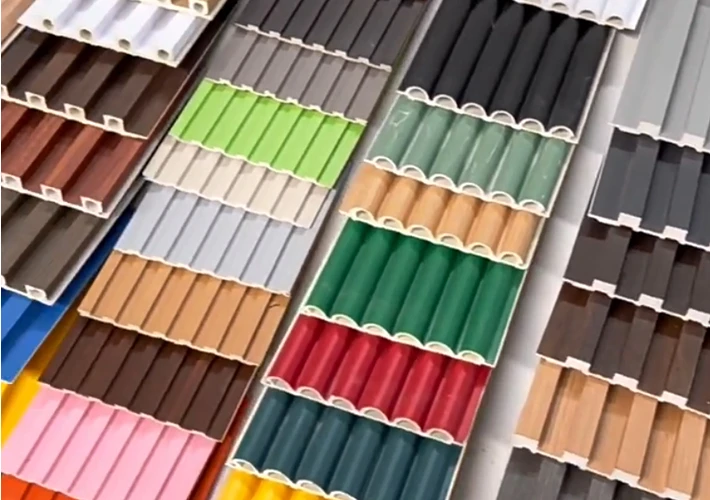
Check Certifications, Test Reports, and Market Compliance
Certification and testing should be evaluated according to your target market and application.
Different countries and projects can have different requirements, so buyers should first identify which standards are actually relevant to their market.
Depending on the product and destination, you may need to review documents related to:
- Quality management
- Fire performance
- Formaldehyde or VOC emissions
- Environmental requirements
- Chemical restrictions
- Product safety
- Wood sourcing
- Building material compliance
Common documents encountered in international WPC sourcing include ISO 9001, CE-related documentation where applicable, SGS or other third-party test reports, FSC-related documentation, and fire-performance reports such as ASTM E84 or EN 13501-1 when applicable to the specific product and market.
However, buyers should not assume that a certificate automatically applies to every product from a supplier.
Always check:
- Which product was tested?
- Which model or specification was tested?
- What was the test date?
- Which laboratory issued the report?
- Does the report cover the performance requirement of your target market?
- Can the supplier provide the original or verifiable document?
This is especially important for distributors supplying commercial projects, hotels, offices, public buildings, and other applications where documentation may be required.
Compare Production Capacity, MOQ, and Lead Time
A supplier may provide excellent samples but still fail to meet your requirements once you place a large order.
This is why production capacity and supply stability matter.
Before selecting a WPC wall panel manufacturer, ask:
- What is the monthly production capacity?
- How many production lines are available?
- What is the standard production lead time?
- What is the MOQ per color?
- What is the MOQ per profile?
- Can different SKUs be mixed in one container?
- How are urgent orders handled?
- Does the supplier maintain raw material inventory?
For distributors, MOQ is especially important.
A supplier with an extremely high MOQ may not be suitable for a new market. On the other hand, a supplier with an unrealistically low MOQ may not provide competitive pricing for larger distribution programs.
A practical purchasing strategy is to start with a manageable trial order, evaluate market response, and then gradually increase purchasing volume.
For example:
Trial stage: Test several popular colors and profiles.
Market stage: Identify the best-selling SKUs.
Growth stage: Increase container volume for high-demand products.
Private-label stage: Develop customized colors, packaging, or profiles.
Lead time should also be clearly defined in the quotation and sales contract. Production time, quality inspection, packaging, and container loading should all be considered when planning your delivery schedule.
Look for OEM and ODM Capabilities
If you are a distributor or brand owner, product differentiation can become an important competitive advantage.
A supplier that only sells standard products may limit your ability to develop a unique product line.
A manufacturer offering OEM and ODM services can potentially support:
- Custom colors
- Custom panel dimensions
- Custom profiles
- Custom surface textures
- Private-label packaging
- Custom product codes
- Customized installation instructions
- Brand logos
- Product catalogs
- New product development
OEM is generally more suitable when you already have specific product requirements and want the manufacturer to produce according to your specifications.
ODM is often more suitable when you want to select an existing product platform and customize elements such as color, packaging, or branding.
For companies entering the WPC wall panel market, ODM can provide a faster way to launch products. For established brands seeking differentiation, OEM can provide greater control over product specifications and branding.
Before starting customization, clarify who owns the mold, artwork, product design, packaging design, and other intellectual property.
Compare Price Based on Total Value, Not Just Unit Cost
Price is obviously important in B2B purchasing, but choosing a supplier based solely on the lowest quotation can create unnecessary risks.
When comparing WPC wall panel suppliers, calculate the total landed cost.
This may include:
Product price + packaging cost + tooling cost + inspection cost + shipping cost + insurance + import duties + potential replacement cost
For example, Supplier A may offer a lower FOB price, but Supplier B may provide better packaging, more stable quality, shorter lead times, and fewer damaged panels.
If Supplier A has a higher defect or damage rate, its apparent price advantage may disappear.
Ask every supplier to provide a detailed quotation containing:
- Product model
- Dimensions
- Thickness
- Material specification
- Surface finish
- Color
- Packaging
- MOQ
- Unit price
- Trade terms
- Lead time
- Payment terms
- Sample policy
- Customization cost
This allows you to compare suppliers on the same basis.
You should also be cautious about prices that are significantly below the market range. Extremely low prices can sometimes result from differences in material formulation, panel density, surface treatment, packaging, or quality control. Industry sourcing guidance similarly recommends evaluating unusually low prices together with raw-material and production information rather than assuming that lower cost means better value.
Evaluate Export Experience, Service, and Long-Term Partnership Potential
For international B2B buyers, manufacturing capability is only part of the equation.
A good export supplier should understand international logistics and documentation.
Ask whether the supplier regularly handles:
- Commercial invoices
- Packing lists
- Bills of lading
- Certificates of origin
- Customs documents
- Container loading
- Export packaging
- Shipping coordination
Export experience can reduce communication problems and help prevent documentation or shipping delays.
Communication is equally important.
A professional supplier should be able to provide:
- Fast quotation responses
- Clear product specifications
- Accurate order confirmation
- Production updates
- QC photos or videos
- Packing information
- Shipping updates
- Technical installation support
Long-term cooperation should also be considered.
If you plan to grow your WPC wall panel business over the next several years, ask whether the supplier can support increasing order volumes and new product development.
The ideal supplier should be capable of moving with your business—from samples to trial orders, then from container orders to private-label or customized product lines.
Why Choose Aesthedge as Your WPC Wall Panel Supplier?
For international buyers looking for a China-based WPC wall panel manufacturing partner, Aesthedge focuses on providing B2B-oriented decorative wall panel solutions for importers, distributors, wholesalers, contractors, and project buyers.
As a Chinese factory-oriented brand, Aesthedge understands that international buyers need more than attractive product photos. They need stable specifications, consistent quality, reliable production, professional export support, and flexible customization.
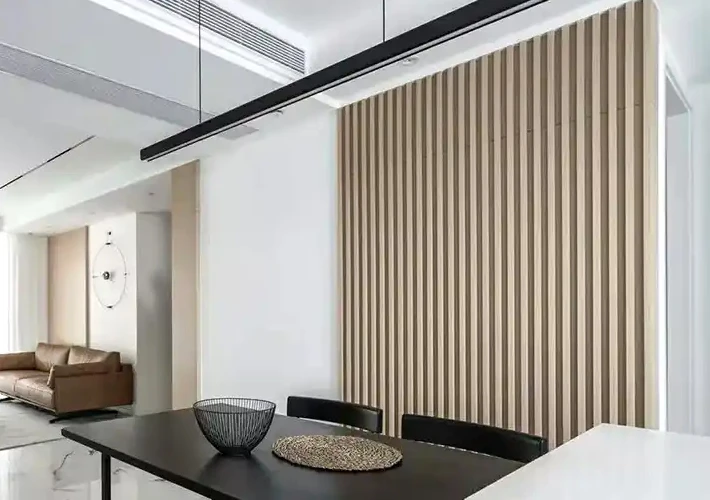
Aesthedge can support buyers looking for a range of decorative wall panel solutions, including WPC wall panels and modern fluted and 3D decorative designs.
Key advantages include:
Factory-Based Manufacturing
Direct cooperation with a manufacturer can simplify communication between the buyer and production team and provide better visibility into product specifications and quality control.
Wide Product Selection
Different projects require different visual styles. WPC wall panels can be supplied in various profiles, textures, colors, and decorative finishes to suit residential, hospitality, commercial, and retail applications.
OEM and ODM Support
For distributors and brands, customized colors, packaging, specifications, and product solutions can help create a more differentiated product portfolio.
B2B Export Support
Aesthedge focuses on international B2B customers and can support buyers through product selection, quotations, samples, production coordination, packaging, and export arrangements.
Project-Oriented Solutions
Instead of treating every order as a simple product transaction, a professional supplier should understand the buyer’s application, target market, required specifications, and expected purchasing volume.
This approach helps buyers select the appropriate WPC wall panel rather than simply selecting the cheapest available product.
WPC Wall Panel Supplier Selection Checklist
Before signing a long-term supply agreement, use the following checklist:
- Verify that the supplier has genuine manufacturing capability.
- Check the factory address and business information.
- Request a live factory video or arrange an on-site audit.
- Ask about extrusion lines and production capacity.
- Request complete product specifications.
- Confirm the material formulation and panel structure.
- Request physical samples before bulk purchasing.
- Test surface quality, dimensions, color, and installation performance.
- Review relevant certification and third-party testing documents.
- Confirm that testing documents apply to the actual product.
- Compare MOQ requirements.
- Confirm production lead time.
- Compare packaging standards.
- Check container loading methods.
- Confirm OEM/ODM capabilities if required.
- Clarify customization and tooling costs.
- Confirm payment and trade terms.
- Evaluate export documentation support.
- Establish a pre-shipment inspection procedure.
- Confirm after-sales and replacement policies.
This process can help reduce the risks associated with large-volume international purchasing.
Conclusion
Choosing the best WPC wall panel supplier for your business requires a comprehensive evaluation rather than a simple price comparison.
The most important factors include factory authenticity, raw material quality, product consistency, certifications, production capacity, MOQ, lead time, OEM/ODM capability, export experience, packaging, communication, and after-sales service.
For importers and distributors, the ideal supplier should be able to provide consistent quality today while also supporting your business as it grows.
Before placing a large order, always request samples, verify technical specifications, check relevant testing documents, evaluate the factory’s production capability, and confirm all commercial terms in writing.
For businesses sourcing WPC wall panels from China, Aesthedge provides a factory-oriented B2B supply solution focused on quality, customization, stable production, and international market requirements.
If you are looking for a reliable WPC wall panel supplier in China, contact Aesthedge for product catalogs, samples, specifications, OEM/ODM options, and a project quotation.
Aesthedge — Your Reliable WPC Wall Panel Manufacturing Partner in China.