As modern office environments continue to evolve toward open layouts, collaborative workspaces, and flexible interiors, acoustic performance has become a critical design and operational requirement. Office acoustic panels are no longer decorative accessories; they are functional building materials that directly influence productivity, privacy, employee well-being, and regulatory compliance.
Over the past decade, a clear global sourcing pattern has emerged. China has become the primary manufacturing and export hub for office acoustic panels, supplying distributors, project contractors, architects, and corporate procurement teams worldwide.
This dominance is not based on price alone. Instead, it reflects a combination of industrial scale, technical maturity, customization capability, and supply-chain efficiency that few other regions can match. This article explains, from a professional B2B perspective, why global buyers consistently choose China as their sourcing destination for office acoustic panels.
Global Demand Drivers for Office Acoustic Panels
The growth of the office acoustic panel market is closely tied to structural changes in how offices are designed and used.
Open-plan offices, while cost-efficient and visually modern, introduce significant acoustic challenges. Hard surfaces such as glass partitions, concrete ceilings, and metal frames reflect sound rather than absorb it. As a result, noise transmission, echo, and speech interference become common problems, particularly in meeting rooms, call centers, and collaborative zones.
At the same time, multinational corporations and institutional employers increasingly link acoustic comfort to:
- Employee productivity and concentration
- Speech privacy and data protection
- Workplace wellness standards
- Green building certifications such as LEED and WELL
These factors have turned acoustic panels into standard specification items rather than optional upgrades. As demand rises globally, buyers require suppliers capable of delivering large volumes, consistent performance, and compliance with international standards—criteria that strongly favor China-based manufacturers.
China’s Manufacturing Scale and Industrial Clusters
One of the most decisive reasons global buyers source office acoustic panels from China is manufacturing scale.
China is home to highly concentrated industrial clusters dedicated to decorative building materials, including acoustic solutions. Within these clusters, factories specializing in raw materials, panel forming, surface finishing, packaging, and logistics operate in close proximity. This ecosystem structure allows manufacturers to optimize cost, speed, and quality simultaneously.
For international buyers, this scale translates into:
- High-volume production capacity for large office projects
- Shorter lead times even for customized orders
- Reduced supply risk during peak construction seasons
Unlike regions where acoustic panels are produced in smaller workshops or fragmented supply chains, Chinese factories are structured to serve global B2B demand, not just domestic markets.
Cost–Performance Balance Rather Than Low-Price Competition
A common misconception among first-time buyers is that sourcing from China is driven purely by low pricing. In reality, experienced global buyers focus on cost–performance ratio, not unit price alone.
Chinese acoustic panel manufacturers benefit from:
- Automated and semi-automated production lines
- Local access to polyester fiber, MDF, PET felt, and fabric materials
- Efficient labor allocation and production planning
- Mature export logistics infrastructure
These advantages allow factories to deliver stable acoustic performance, consistent quality, and competitive pricing at scale. For project-based procurement, this balance is far more valuable than the lowest possible price, particularly when acoustic panels are installed across hundreds or thousands of square meters.
As a result, China is often chosen not because it is the cheapest option, but because it offers predictable quality at commercially sustainable costs.

Technical Capability and Acoustic Performance Standards
Modern office projects require acoustic panels that perform to measurable standards, not just aesthetic expectations. Chinese manufacturers have significantly upgraded their technical capabilities to meet this demand.
Many factories now invest in:
- NRC (Noise Reduction Coefficient) testing
- Sound absorption optimization by thickness and density
- Precision perforation and lamination technology
- Stable bonding and edge treatment processes
Office acoustic panels exported from China are commonly designed to comply with:
- ASTM acoustic standards for North America
- EN and ISO standards for Europe
- Fire-rating classifications such as Class A, B, or B-s1,d0
For global buyers, this means acoustic panels sourced from China are suitable for commercial office buildings, government projects, and regulated environments, not just decorative applications.
Product Diversity for Different Office Applications
Another major reason buyers source from China is the breadth of available product solutions.
Chinese manufacturers typically offer complete office acoustic panel portfolios, including:
- Polyester fiber acoustic panels
- Fabric-wrapped wall panels
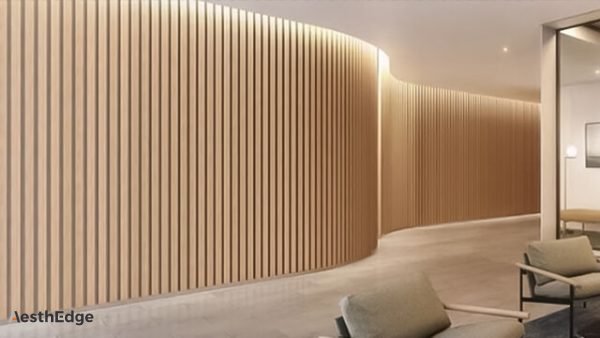
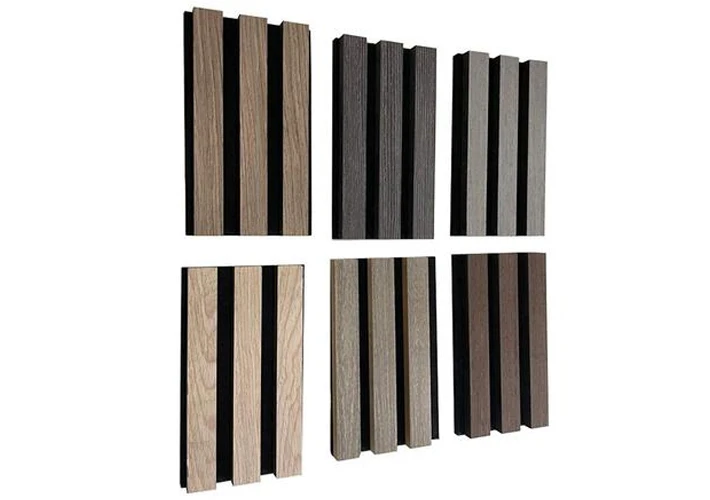
- Slat wood acoustic panels
- Perforated MDF acoustic boards
- PET felt ceiling baffles and clouds
This diversity allows buyers to source multiple acoustic solutions from a single supplier, ensuring consistency in color, performance, and installation systems across different office zones.
From open workspaces and conference rooms to executive offices and reception areas, Chinese factories are accustomed to supplying application-specific acoustic solutions rather than generic panels.

Customization Capability for Global Office Projects
Office acoustic panels are rarely standardized products. Architectural design, branding requirements, and spatial constraints demand customization, and this is one of China’s strongest competitive advantages.
Chinese manufacturers offer flexible customization options, including:
- Non-standard panel sizes and thicknesses
- Custom colors, fabrics, and surface finishes
- Wood veneer or printed decorative layers
- Acoustic performance tuning for specific environments
This flexibility is particularly valuable for:
- International office fit-out projects
- Corporate headquarters with brand identity requirements
- Retrofit projects with irregular wall or ceiling dimensions
For global buyers, working with suppliers that can adapt production quickly is often more important than working with suppliers that offer limited standard catalogs.
Export Experience, Logistics, and OEM Support
China’s role as a global manufacturing hub is reinforced by its export infrastructure and B2B trade experience.
Most acoustic panel factories in China are highly familiar with:
- Container loading optimization
- Export-grade packaging
- International trade terms such as FOB, CIF, and DDP
- Customs documentation and compliance requirements
In addition, Chinese manufacturers provide strong OEM and private-label support, including:
- Customized branding and packaging
- Product documentation and installation guides
- Long-term supply agreements for distributors
This makes China an ideal sourcing destination not only for project contractors, but also for wholesalers and regional brands seeking to build their own acoustic panel product lines.

Why China Remains the Preferred Sourcing Destination
For global buyers, sourcing office acoustic panels is a strategic decision that affects project timelines, budgets, and long-term partnerships.
China remains the preferred sourcing destination because it combines:
- Industrial-scale manufacturing
- Proven acoustic engineering capability
- Customization flexibility
- Stable quality control
- Competitive cost structures
- Deep experience in global B2B trade
Rather than acting solely as a low-cost supplier, China has evolved into a strategic manufacturing partner for the global office acoustic panel industry.
As office environments continue to prioritize acoustic comfort, sustainability, and design integration, Chinese manufacturers are well-positioned to meet these evolving requirements at scale.