In today’s highly competitive hospitality market, time has become one of the most expensive costs in hotel projects.
For hotel owners, developers, and international operators, delays in guestroom renovation often mean:
- Missing peak-season opening windows
- Increased labor and management costs
- Higher financial pressure from delayed ROI
- Contract risks with brands and investors
While many project teams try to solve delays by hiring more workers or accelerating construction schedules, successful hotel projects around the world are discovering a different truth:
The real determinant of renovation speed is not the contractor — it is material selection.
This article explains, from a real project and construction perspective, how smart material choices can realistically reduce hotel guestroom renovation time by 30% or more, without compromising quality or brand standards.
Why Hotel Guestroom Renovations Are Frequently Delayed
Despite detailed planning, hotel renovation schedules often run over time. The reasons are surprisingly consistent across markets such as the US, Europe, the Middle East, and Southeast Asia.
1.1 Excessive Wet Trades Slow Everything Down
Traditional hotel renovation relies heavily on wet construction processes, including:
- Cement leveling
- Tile installation
- Stone setting
- On-site painting
These processes require drying, curing, and waiting periods that are often underestimated during planning.
In a typical hotel guestroom, 25–35% of total renovation time is lost to passive waiting, not active construction.
Once one wet process is delayed, all subsequent trades are forced to wait.
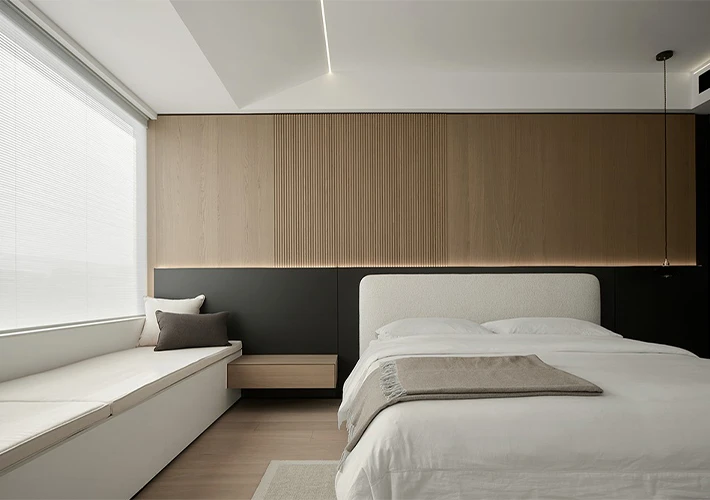
1.2 Too Many Separate Material Systems Increase Coordination Costs
Many hotel projects source different components from different suppliers:
- Wall finishes
- Ceilings
- Door frames
- Skirting and trims
Each system has its own installation method, tolerance, and schedule requirement. This leads to:
- Trade conflicts
- Rework at junction points
- Multiple teams waiting for each other
As complexity increases, schedule control becomes extremely difficult.
1.3 Materials Are Not Designed for Standardized Hotel Rooms
Hotel guestrooms are highly standardized spaces, yet many traditional materials are:
- Designed for residential or custom projects
- Dependent on skilled craftsmanship
- Impossible to pre-fabricate or modularize
This mismatch directly conflicts with the hotel industry’s need for fast, repeatable, large-scale delivery.
The Core Logic Behind a 30% Faster Renovation
Projects that achieve significant time savings do not rely on shortcuts. Instead, they follow a material-driven strategy.
2.1 Shift from “Construction-Oriented” to “Material-Oriented Planning”
Instead of asking:
- “How fast can workers build this?”
Successful projects ask:
- “Which materials are designed to be installed fast?”
2.2 Three Proven Material Selection Principles
Hotel projects that reduce renovation time by 30% typically follow these rules:
- Replace wet trades with dry installation systems
- Increase integration and reduce on-site processes
- Use factory-finished, semi-complete material systems

Wall Systems: The Biggest Opportunity for Time Reduction
Wall construction is often the largest time bottleneck in guestroom renovation.
3.1 Time Cost of Traditional Wall Finishes
Typical traditional wall workflows include:
- Substrate leveling
- Multiple layers of finishing
- On-site painting or tiling
- Mandatory drying periods
Each step adds uncertainty and risk.
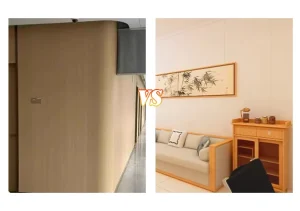
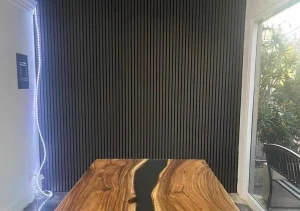
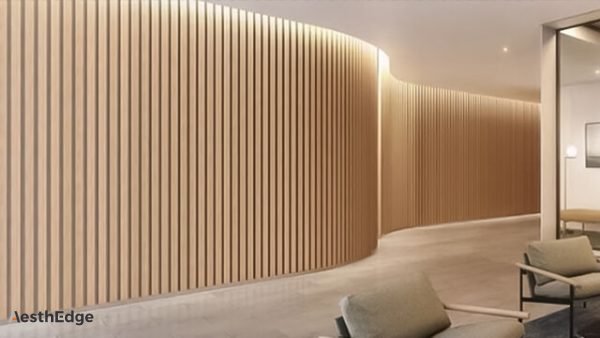
3.2 Why Modular Wall Panels Are Gaining Popularity
More hotel projects now use:
- SPC wall panels
- PVC composite wall panels
- Bamboo charcoal decorative panels
- Pre-finished decorative wall systems
Key advantages include:
- Factory-finished surfaces
- No plastering or painting
- Immediate installation after unpacking
Wall installation time per guestroom can be reduced from 3–5 days to less than 1 day.
3.3 Traditional Walls vs. Modular Wall Panels
| Item | Traditional Wall Finish | Modular Wall Panels |
|---|---|---|
| Wet trades required | Yes | No |
| Drying time | Required | None |
| Installation skill dependency | High | Medium |
| Installation speed | Slow | Very fast |
| Rework risk | High | Low |
Flooring Selection: Avoiding the “Waiting for the Floor” Problem
4.1 Limitations of Tile and Stone Flooring
Tile and stone are widely used but bring challenges:
- Cement-based installation
- Strict flatness requirements
- Grouting and curing delays
These delays directly impact furniture, FF&E, and soft furnishing installation.
4.2 Why SPC Flooring Is Preferred in Hotel Projects
SPC flooring is becoming a standard solution for hotel guestrooms due to:
- Click-lock dry installation
- No adhesive or curing required
- Can be installed over existing floors
For renovation projects, this enables phased construction without full hotel closure.
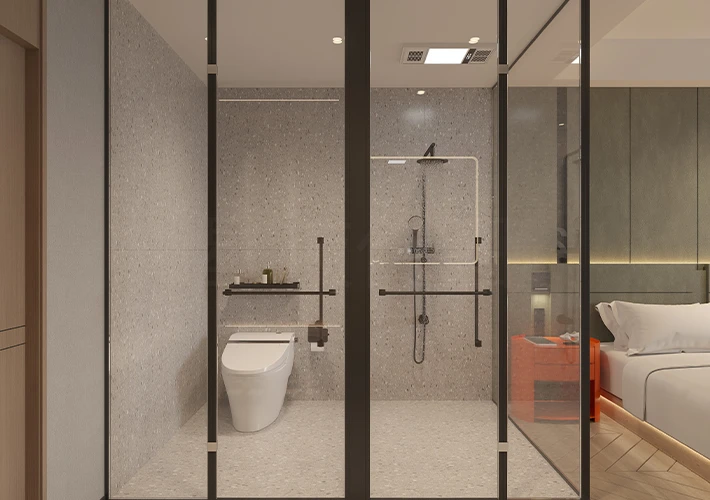
Bathroom Areas: Where Most Delays Originate
Bathrooms are often the highest-risk zone for schedule overruns.
5.1 Traditional Bathroom Construction Issues
- Waterproof layers require curing time
- Tile installation is labor-intensive
- Skilled workmanship is critical
Any error results in rework, leakage risk, and inspection delays.
5.2 Faster Bathroom Solutions for Hotels
Advanced hotel projects now use:
- Waterproof wall panel systems
- Prefabricated shower enclosures
- Modular bathroom components
Benefits include:
- Factory-tested waterproof performance
- Minimal on-site wet work
- Parallel installation with other trades
Ceilings and Doors: Small Choices, Big Schedule Impact
6.1 Integrated Ceilings vs. Gypsum Ceilings
| Item | Gypsum Ceiling | Integrated Ceiling System |
|---|---|---|
| Installation method | On-site finishing | Modular |
| Drying required | Yes | No |
| Maintenance access | Difficult | Easy |
| Installation speed | Slow | Fast |
Integrated ceilings allow lighting, HVAC diffusers, and access panels to be installed simultaneously.
6.2 Door Frames, Skirting, and Trims as One System
Using unified materials for:
- Door frames
- Skirting boards
- Wall trims
reduces alignment issues and finishing delays while improving visual consistency.
Supply Chain Capability: The Hidden Factor Behind Fast Delivery
Fast-install materials only work if the supplier can support them.
Reliable hotel material suppliers typically offer:
- Stable mass production capacity
- Consistent size tolerances
- Export-ready packaging
- Clear installation manuals
This is why many international hotel projects now cooperate directly with experienced Chinese manufacturers, who specialize in large-volume, standardized hotel materials.

Case Study: How Material Selection Reduced Renovation Time by 30%
Project Overview:
- 150 guestrooms
- Mid-scale international hotel
| Item | Traditional Approach | Optimized Approach |
|---|---|---|
| Total renovation time | 120 days | 80–85 days |
| Wall system | Wet finish | Modular panels |
| Flooring | Ceramic tiles | SPC flooring |
| Ceiling | Gypsum | Integrated ceiling |
| Rework rate | High | Low |
Result:
👉 Overall renovation time reduced by approximately 30%.
Conclusion: Hotel Renovation Speed Is a System Competition
In modern hotel projects, faster renovation is not about rushing — it is about designing for speed from the beginning.
The most successful projects understand that:
- Materials are not just finishes
- Materials are delivery systems
- The right materials reduce labor dependency, risk, and delays
If you are planning a hotel construction or renovation project and aim to open faster, control costs, and protect quality, material selection should be treated as a strategic decision — not a last-minute choice.